


- 当前位置:首页 > >Merck Millipore > 生命科学研究
- 生命科学研究
-
-
merck millipore,默克密理博,15-103,PI3 Kinase/Akt/GSK3 Pathway Explorer Minipack
产品名称:PI3 Kinase/Akt/GSK3 Pathway Explorer Minipack
产品型号:15-103
This Antibody pack contains Anti-PI3 Kinase Antibody, Anti-Akt/PKB Antibody, Anti-GSK3α/β Antibody validated for use in Enzyme Assay, ICC, IF, Flow, IP & WB.
merck millipore,默克密理博,15-103,PI3 Kinase/Akt/GSK3 Pathway Explorer Minipack
- 产品介绍
描述 产品目录编号 15-103 品牌系列 Upstate
商名 - Upstate
描述 PI3 Kinase/Akt/GSK3 Pathway Explorer Minipack Alternate Names - glycogen synthase kinase 3 beta
- Protein kinase B
- RAC-alpha serine/threonine-protein kinase
- rac protein kinase alpha
- v-akt murine thymoma viral oncogene homolog 1
- murine thymoma viral (v-akt) oncogene homolog-1
- glycogen synthase kinase 3 alpha
背景信息 Pathway Explorer Antibody MiniPack:
Each Pathway Explorer Antibody Minipack contains three related antibodies as part of a signaling cascade or a combination of total and phosphorylated forms of key signaling targets. Each of the three antibodies are 30% the original pack size. Full size versions of each of the Pathway Explorer antibodies are available for sale individually under the same catalog number with the removal of “SP” off of each one (e.g. 05-591SP can be ordered as 05-591).
PI3 Kinase:
PI3 Kinase (Phosphatidylinositol 3-Kinase) is responsible for phosphorylation of the 3 position of the inositol ring of PI(4,5)P2, to generate PI(3,4,5)P3, a potent second messenger required for survival signaling, and insulin action. PI3 Kinase is a heterodimeric complex composed of an 85 kDa regulatory subunit and a 110 kDa catalytic subunit. Tyrosine phosphorylation of growth factor receptors creates docking sites for binding of p85 (through its SH2 domains) on the receptors; p85 brings with it p110, which is then proximal to its phospho-lipid substrate on the membrane. PI3 Kinase is also activated by Ras, and by the β-γ subunits of heterotrimeric G-proteins. PI3 Kinase is inhibitable by wortmannin, a useful tool for the study of the PI3 Kinase signaling pathway.
Akt/PKB, PH Domain:
Akt (protein kinase B), a serine/threonine kinase, has emerged as a critical enzyme in signal transduction pathways involved in cell proliferation, apoptosis, angiogenesis, and diabetes. In mammals three isoforms of Akt (α,β, γ or Akt 1, 2, 3) are reported that exhibit a high degree of homology, but differ slightly in the localization of their regulatory phosphorylation sites. Aktα is the predominant isoform in most tissues, whereas the highest expression of Aktβ is observed in the insulin-responsive tissues, and Aktγ is abundant in brain tissue. Each Akt isoform is composed of three functionally distinct regions: an N-terminal pleckstrin homology (PH) domain that provides a lipid-binding module to direct Akt to PIP3, a central catalytic domain, and a C-terminal hydrophobic motif.
GSK3α/β:
Glycogen synthase kinase-3 (GSK-3), a multifunctional serine/threonine kinase, is a key regulator of numerous signaling pathways. Two isoforms of GSK-3 are reported in mammals: a 51 kDa GSK-3α and a 47 kDa GSK-3β. These two isoforms exhibit about 98% homology in their kinase domains, but share only about 36% identity in the last 76 C-terminal amino acid residues. GSK-3α contains a glycine-rich extension at its N-terminus. A minor (~15% of total) splice variant of GSK-3β, GSK-3β2, has also been identified, which contains a 13-residue insert within the kinase domain. It exhibits reduced kinase activity towards the Tau protein compared with ‘unspliced’ GSK-3β. GSK-3β2 is localized primarily to neuronal cell bodies, unlike unspliced GSK-3β that is also found in neuronal processes. GSK-3β plays a key inhibitory role in the Wnt signaling pathway. Wnt genes encode a large family of secreted, cysteine-rich proteins that are important in development and in maintenance of adult tissues. Abnormalities in Wnt signaling are reported to promote both human degenerative diseases and cancer.
* See full size versions for corresponding references.产品信息 部件 - 05-412SP Anti-GSK3α/β, clone 4G-1E
- 06-195SP Anti-PI3 Kinase, p85
- 05-591SP Anti-Akt/PKB, PH Domain, clone SKB1
控制 - 06-195SP:Jurkat cell lysate.
Included Positive Antigen Control: Catalog # 12-303, Jurkat cell lysate. Add 2.5 µL of 2-mercaptoethanol per 100 µL of lysate and boil for 5 minutes to reduce the preparation. Load 20 µg of reduced lysate per lane for minigels. - 05-412SP: Included Positive Antigen Control: Catalog # 12-303, Jurkat lysate. Add 2.5 µL of 2-mercaptoethanol per 100 µL of lysate and boil for 5 minutes to reduce the preparation. Use 20 µg per lane for minigels.
演示 3 individual tubes containing either Anti-PI3 Kinase, p85; Anti-Akt/PKB, PH Domain, clone SKB1; or Anti-GSK3α/β, clone 4G-1E 性质 Each vial is 30% the size of the parent catalog number 应用 应用 This Antibody pack contains Anti-PI3 Kinase Antibody, Anti-Akt/PKB Antibody, Anti-GSK3α/β Antibody validated for use in Enzyme Assay, ICC, IF, Flow, IP & WB. 主要应用 - Western Blotting
- Immunocytochemistry
- Flow Cytometry
不建议的应用 - Immunoprecipitation
应用说明 05-412SP: Immunofluorescence Staining:
L6 cells were grown, fixed, and permeabilized.;
Flow Cytometry:
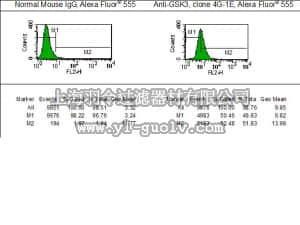
NCI/H292 cells were stained with Anti-GSK3α/β, clone 4G-1E conjugated to Alexa Fluor® 555;Immunoprecipitation: Not recommended for 05-412SP.
06-195SP: Immunoprecipitation: 5 µL of a previous lot immunoprecipitated PI3 kinase from human Jurkat cell lysate as confirmed by subsequent western blot. The antibody will precipitate the 85 kDa subunit.
05-591SP: Immunofluroescence Analysis:
A431 cells were fixed, permeabilized, and stained with anti-Akt, clone SKB1 (2μg/mL) conjugated to AlexaFluor® 488;
Flow Cytometry: NIH/3T3 cells (detached using trypsin-EDTA) per sample were stained with 0.5 μg of anti-Akt/PKB, PH Domain, clone SKB1 (filled histogram) or 1 μg of mouse IgG1 (open histogram) followed by a goat anti-mouse IgG-PE conjugate.
Immunoprecipitation Kinase: 4 μg of a previous lot immunoprecipitated active Akt from 700 μg of L6 cells stimulated with 15nM IGF-1 for 2-5 minutes.
Immunoprecipitation Kinase Assay Data:
The kinase activity of immunoprecipitated Akt/PKB was determined as described above using Akt/SGK Substrate Peptide as a substrate. Active kinase was detected by comparing the incorporation of [32P] into Akt/SGK Substrate Peptide as catalyzed by immunoprecipitates (1 mg) of L6 cell lysates stimulated with 15 nM IGF-1. The test results are shown in the table to the left.
生物信息 免疫原品种 05-412SP: 18 residue synthetic peptide (C-KQLLHGEPNVSYICSRY) corresponding to amino acids 203-219 derived from a region of the catalytic domain (between subdomain VII and VIII) of the Drosophila GSK3/shaggy enzyme, coupled to ovalbumin. Clone 4G-1E.;05-591SP: GST-fusion protein corresponding to residues 1-149 of human Akt1.; 06-195SP: GST fusion proteins containing 1) the N-terminal SH2 domain of rat PI3 kinase and 2) the full length 85 kDa subunit of rat PI3 kinase. 表位 Varies. See individual Data Sheets 克隆 05-412SP: 4G-1E; 05-591SP:SKB1 浓缩 Please refer to the Certificate of Analysis for the lot-specific concentration. 品种反应性 DictyosteliumHumanMouseRatVertebratesMonkeyYeast (S. pombe) Species Reactivity Note 05-412SP: Human, Mouse, Rat, S. pombe, and Dictyostelium. Because of the extremely high conservation of this immunogen among the known enzymes of many different species, this antibody is predicted to cross-react with nearly all species homologues.
05-591SP: Human, mouse and rat; other species cross-reactivity unknown.Entrez基因编号 - NP_476714
- NP_852556
- NP_001014431
Entrez基因汇总 AKT1:The serine-threonine protein kinase encoded by the AKT1 gene is catalytically inactive in serum-starved primary and immortalized fibroblasts. AKT1 and the related AKT2 are activated by platelet-derived growth factor. The activation is rapid and specific, and it is abrogated by mutations in the pleckstrin homology domain of AKT1. It was shown that the activation occurs through phosphatidylinositol 3-kinase. In the developing nervous system AKT is a critical mediator of growth factor-induced neuronal survival. Survival factors can suppress apoptosis in a transcription-independent manner by activating the serine/threonine kinase AKT1, which then phosphorylates and inactivates components of the apoptotic machinery. Multiple alternatively spliced transcript variants have been found for this gene. [provided by RefSeq].
P13 KINASE:Phosphatidylinositol 3-kinase phosphorylates the inositol ring of phosphatidylinositol at the 3-prime position. The enzyme comprises a 110 kD catalytic subunit and a regulatory subunit of either 85, 55, or 50 kD. This gene encodes the 85 kD regulatory subunit. Phosphatidylinositol 3-kinase plays an important role in the metabolic actions of insulin, and a mutation in this gene has been associated with insulin resistance. Alternative splicing of this gene results in three transcript variants encoding different isoforms. [provided by RefSeq].
基因符号 - PIK3R1
- AKT
- Akt1
- GSK3
- Glycogen Synthase Kinase 3
- PKB
- PKB-ALPHA
- PRKBA
- PI3 Kinase
- PI3K
- phosphatidylinositol 3-kinase regulatory subunit
- phosphatidylinositol 3 kinase
UniProt编号 - P27986
- P31749
- P49840
UniProt汇总 PI3 Kinase, p85:
FUNCTION: Binds to activated (phosphorylated) protein-Tyr kinases, through its SH2 domain, and acts as an adapter, mediating the association of the p110 catalytic unit to the plasma membrane. Necessary for the insulin-stimulated increase in glucose uptake and glycogen synthesis in insulin-sensitive tissues.
Subunit structure: Heterodimer of a p110 (catalytic) and a p85 (regulatory) subunits. Interacts with phosphorylated TOM1L1. Interacts with phosphorylated LIME1 upon TCR and/or BCR activation. Interacts with SOCS7. Interacts with RUFY3 By similarity. Interacts with phosphorylated LAT, LAX1 and TRAT1 upon TCR activation. Interacts with CBLB. Interacts with HIV-1 Nef to activate the Nef associated p21-activated kinase (PAK). This interaction depends on the C-terminus of both proteins and leads to increased production of HIV. Interacts with HCV NS5A. The SH2 domains interact with the YTHM motif of phosphorylated INSR in vitro. Also interacts with tyrosine-phosphorylated IGF1R in vitro. Interacts with CD28 and CD3Z upon T-cell activation. Interacts with IRS1 and phosphorylated IRS4, as well as with NISCH and HCST.
TISSUE SPECIFICITY: Isoform 2 is expressed in skeletal muscle and brain, and at lower levels in kidney and cardiac muscle. Isoform 2 and isoform 4 are present in skeletal muscle (at protein level).
DOMAIN: The SH3 domain mediates the binding to CBLB, and to HIV-1 Nef.
Post-translational modification: Polyubiquitinated in T-cells by CBLB; which does not promote proteasomal degradation but impairs association with CD28 and CD3Z upon T-cell activation.
AKT:
FUNCTION: General protein kinase capable of phosphorylating several known proteins. Phosphorylates TBC1D4. Signals downstream of phosphatidylinositol 3-kinase (PI(3)K) to mediate the effects of various growth factors such as platelet-derived growth factor (PDGF), epidermal growth factor (EGF), insulin and insulin-like growth factor I (IGF-I). Plays a role in glucose transport by mediating insulin-induced translocation of the GLUT4 glucose transporter to the cell surface. Mediates the antiapoptotic effects of IGF-I. Mediates insulin-stimulated protein synthesis, partly by playing a role in both insulin-induced phosphorylation of 4E-BP1 and in insulin-induced activation of p70 S6 kinase. Promotes glycogen synthesis by mediating the insulin-induced activation of glycogen synthase.
CATALYTIC ACTIVITY: ATP + a protein = ADP + a phosphoprotein.
ENZYME REGULATION: Three specific sites, one in the kinase domain (Thr-308) and the two other ones in the C-terminal regulatory region (Ser-473 and Tyr-474), need to be phosphorylated for its full activation.
SUBUNIT: Interacts with CENTG1 isoform 2 (PIKE-A) in the presence of guanine nucleotides. The C-terminus interacts with CCDC88A/GRDN and THEM4. Interacts with AKTIP. Interacts (via PH domain) with MTCP1, TCL1A AND TCL1B. Interacts with CDKN1B; the interaction phosphorylates CDKN1B promoting 14-3-3 binding and cell-cycle progression.
SUBCELLULAR LOCATION: Cytoplasm. Nucleus. Cell membrane. Note=Nucleus after activation by integrin-linked protein kinase 1 (ILK1). Nuclear translocation is enhanced by interaction with TCL1A.
TISSUE SPECIFICITY: In all human cell types so far analyzed.
DOMAIN: Binding of the PH domain to the phosphatidylinositol 3-kinase alpha (PI(3)K) results in its targeting to the plasma membrane.
DOMAIN: The AGC-kinase C-terminal mediates interaction with THEM4.
PTM: Phosphorylation on Thr-308, Ser-473 and Tyr-474 is required for full activity. Ser-473 phosphorylation by the Rictor-mTor complex favors Thr-308 phosphorylation by PDPK1. Ser-473 phosphorylation is enhanced by interaction with CENTG1 isoform 2 (PIKE-A). Ser-473 phosphorylation is enhanced in focal cortical dysplasias with Taylor-type balloon cells.
GSK3:
FUNCTION: Participates in the Wnt signaling pathway. Implicated in the hormonal control of several regulatory proteins including glycogen synthase, MYB and the transcription factor JUN. Phosphorylates JUN at sites proximal to its DNA-binding domain, thereby reducing its affinity for DNA. Phosphorylates MUC1 in breast cancer cells, and decreases the interaction of MUC1 with CTNNB1/beta-catenin.
CATALYTIC ACTIVITY: ATP + [tau protein] = ADP + [tau protein] phosphate.
ENZYME REGULATION: Inhibited when phosphorylated by AKT1.
SUBUNIT: Monomer By similarity. Interacts with CABYR, MUC1, NIN and PRUNE.
TISSUE SPECIFICITY: Expressed in testis, thymus, prostate and ovary and weakly expressed in lung, brain and kidney.
POST-TRANSLATIONAL MODIFICATION:Phosphorylated by AKT1 and ILK1.
SEQUENCE SIMILARITIES:Belongs to the protein kinase superfamily. CMGC Ser/Thr protein kinase family. GSK-3 subfamily. Contains 1 protein kinase domain.产品使用声明 使用声明 - Unless otherwise stated in our catalog or other company documentation accompanying the product(s), our products are intended for research use only and are not to be used for any other purpose, which includes but is not limited to, unauthorized commercial uses, in vitro diagnostic uses, ex vivo or in vivo therapeutic uses or any type of consumption or application to humans or animals.
包装信息 数量 3 vials/Pk
上一件merck millipore产品:merck millipore,默克密理博,14-818,Met (D1246N) Protein, active, 10 µg
下一件merck millipore产品:merck millipore,默克密理博,ABS372,Anti-TBXAS1 Antibody
相关产品
 merck millipore,默克密理博,ABD52,Anti-BAF57 Antibody
 merck millipore,默克密理博,69436,pET-11a DNA - Novagen
 merck millipore,默克密理博,AG565,Polycystin-2 Control Peptide for AB9088
 merck millipore,默克密理博,MAB5634,Anti-Spastin Antibody, clone Sp3G11/1
 merck millipore,默克密理博,14-818,Met (D1246N) Protein, active, 10 µg
 merck millipore,默克密理博,ABS372,Anti-TBXAS1 Antibody
 merck millipore,默克密理博,MAB2144,Anti-VCAM-1 Antibody, clone P3C4
merck millipore,默克密理博,GF174,Sonic HedgeHog (Shh) Protein, Human Recombinant
 merck millipore,默克密理博,239822,CXCR4 Antagonist III - Calbiochem
 merck millipore,默克密理博,SF-1116,Frataxin; Human, Cyanine 5 RNA Detection Probe,SmartFlare