- 当前位置:首页 > >Merck Millipore > 生命科学研究
- 生命科学研究
-
-
merck millipore,默克密理博,MAB1563,Anti-Presenilin-1 Antibody, NT, clone hPS1-NT
产品名称:Anti-Presenilin-1 Antibody, NT, clone hPS1-NT
产品型号:MAB1563
This Anti-Presenilin-1 Antibody, N-terminus, clone hPS1-NT is validated for use in ELISA, IH, IP, WB for the detection of Presenilin-1.
merck millipore,默克密理博,MAB1563,Anti-Presenilin-1 Antibody, NT, clone hPS1-NT
- 产品介绍
重要规格表
品种反应性 主要应用 宿主 格式 抗体类型 H WB, ELISA, IHC R Culture Supernatant Monoclonal Antibody 描述 产品目录编号 MAB1563 品牌系列 Chemicon®
商名 - Chemicon
描述 Anti-Presenilin-1 Antibody, NT, clone hPS1-NT 产品信息 格式 Culture Supernatant 控制 - Brain tissue
演示 UnPurified mouse tissue culture supernatant from a perfusion system, filtered through a 0.2μ micron membrane prior to vialing. Product contains 20%FBS and Ciprofloxacin at final concentration of 10μg/mL. 应用 应用 This Anti-Presenilin-1 Antibody, N-terminus, clone hPS1-NT is validated for use in ELISA, IH, IP, WB for the detection of Presenilin-1. 主要应用 - Western Blotting
- ELISA
- Immunohistochemistry
应用说明 Immunohistochemistry: rat pups and 24 old month rats were perfused for 10 minutes with 100-200mL of 4% PFA 0.3% glutaraldehyde and 0.1% CaCl2 in 0.1M PBS pH 7.4. Vibratome sections were blocked with 3% normal serum and permeabilized with 0.1% triton X-100.{Neuroscience 2003 120:405-423}.
Immunoblotting: 1:250-1:500. Recommend blocking buffer is TBS containing 5% non fat milk and 0.01% Tween 20. It is recommended that you also dilute the antibody in this blocking buffer. Incubate with the MAB1563 for 1 to 2 hours at room temperature or overnight at 4°C.
Immunoprecipitation
ELISA
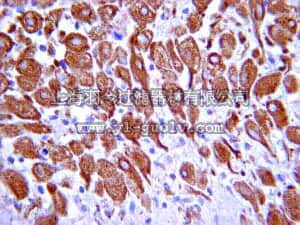
Optimal working dilutions must be determined by end user.生物信息 免疫原品种 A fusion protein antigen containing the N-terminus of human PS-1 (residues 21-80) fused to GST. 表位 N-terminus 克隆 hPS1-NT 浓缩 Please refer to the Certificate of Analysis for the lot-specific concentration. 宿主 Rat 特异性 Recognizes Presenilin-1, human. By Western blot the antibody recognizes a predominant 32 kDa polypeptide in a variety of samples, including PC12 cells transfected with human PS1 complementary DNA, brain biopsy specimens from demented patients, and postmortem samples of frontal neucortex from Familial Alzheimer's Disease cases, late-onset Alzheimer's disease cases, and cases of other degenerative disorders. Immunohistochemical studies of control brains revealed that PS1 is expressed primarily in neurons, with the protein localizing in the soma and dendritic processes. In contrast in FAD and sporadic Alzheimer's disease cases, PS1 immunoreactivity was present in the neuritic component of senile plaques as well as in neurofibrillary tangles. Localization of PS1 immunoreactivity in familial and sporadic Alzheimer's disease suggest that genetically heterogeneous forms of the disease share a common pathophysiology involving PS1 protein. 同种型 IgG2a 品种反应性 Human 抗体类型 Monoclonal Antibody Entrez基因编号 - NM_000021.2
Entrez基因汇总 Alzheimer's disease (AD) patients with an inherited form of the disease carry mutations in the presenilin proteins (PSEN1; PSEN2) or in the amyloid precursor protein (APP). These disease-linked mutations result in increased production of the longer form of amyloid-beta (main component of amyloid deposits found in AD brains). Presenilins are postulated to regulate APP processing through their effects on gamma-secretase, an enzyme that cleaves APP. Also, it is thought that the presenilins are involved in the cleavage of the Notch receptor, such that they either directly regulate gamma-secretase activity or themselves are protease enzymes. Multiple alternatively spliced transcript variants have been identified for this gene, the full-length natures of only some have been determined. 基因符号 - Presenilin-1 CTF12 (PS1-CTF12)].
- PSEN1
- PS1
- FAD
- PSNL1
- PS-1
- AD3
- S182
- Presenilin-1
- EC 3.4.23.- [Contains: Presenilin-1 NTF subunit
- Presenilin-1 CTF subunit
纯化方法 Unpurified UniProt编号 - P49768
UniProt汇总 FUNCTION: SwissProt: P49768 # Probable catalytic subunit of the gamma-secretase complex, an endoprotease complex that catalyzes the intramembrane cleavage of integral membrane proteins such as Notch receptors and APP (beta-amyloid precursor protein). Requires the other members of the gamma-secretase complex to have a protease activity. May play a role in intracellular signaling and gene expression or in linking chromatin to the nuclear membrane. Stimulates cell-cell adhesion though its association with the E-cadherin/catenin complex. Under conditions of apoptosis or calcium influx, cleaves E-cadherin promoting the disassembly of the E-cadherin/catenin complex and increasing the pool of cytoplasmic beta-catenin, thus negatively regulating Wnt signaling. May also play a role in hematopoiesis.
SIZE: 467 amino acids; 52668 Da
SUBUNIT: Homodimer. Component of the gamma-secretase complex, a complex composed of a presenilin homodimer (PSEN1 or PSEN2), nicastrin (NCSTN), APH1 (APH1A or APH1B) and PEN2. Such minimal complex is sufficient for secretase activity. Other components which are associated with the complex include SLC25A64, SLC5A7, PHB and PSEN1 isoform 3. Predominantly heterodimer of a N-terminal (NTF) and a C-terminal (CTF) endoproteolytical fragment. Associates with proteolytic processed C-terminal fragments C83 and C99 of the amyloid precursor protein (APP). Associates with NOTCH1. Component of cadherin/catenin adhesion complexes through direct binding to CDH1 or CDH2. Interaction with CDH1 stabilizes the complex and stimulates cell-cell aggregation. Interaction with CDH2 is essential for trafficking of CDH2 from the endoplasmic reticulum to the plasma membrane. Interacts with CTNND2, CTNNB1, HERPUD1, FLNA, FLNB, MTCH1, PKP4 and PARL. Interacts through its N-terminus with isoform 3 of GFAP. Interacts with DOCK3 (By similarity).
SUBCELLULAR LOCATION: Endoplasmic reticulum membrane; Multi-pass membrane protein. Golgi apparatus membrane; Multi-pass membrane protein. Cell surface. Note=Bound to NOTCH1 also at the cell surface. Colocalizes with CDH1/2 at sites of cell-cell contact. Colocalizes with CTNNB1 in the endoplasmic reticulum and the proximity of the plasma membrane. Also present in azurophil granules of neutrophils.
TISSUE SPECIFICITY: Expressed in a wide range of tissues including various regions of the brain, liver, spleen and lymph nodes.
DOMAIN: SwissProt: P49768 The PAL motif is required for normal active site conformation.
PTM: Heterogeneous proteolytic processing generates N-terminal (NTF) and C-terminal (CTF) fragments of approximately 35 and 20 kDa, respectively. During apoptosis, the C-terminal fragment (CTF) is further cleaved by caspase-3 to produce the fragment, PS1- CTF12. & After endoproteolysis, the C-terminal fragment (CTF) is phosphorylated on serine residues by PKA and/or PKC. Phosphorylation on Ser-346 inhibits endoproteolysis.
DISEASE: SwissProt: P49768 # Defects in PSEN1 are a cause of familial early-onset Alzheimer disease type 3 (AD3) [MIM:607822]. AD3 is the most severe form of the disease, with complete penetrance and an onset occurring as early as 30 years of age. The second form is late- onset AD (LOAD), with mean age of onset greater than 58 years. AD is an autosomal dominant neurodegenerative disorder characterized by progressive dementia, parkinsonism, and deposition of fibrillar amyloid proteins as intraneuronal neurofibrillary tangles, extracellular amyloid plaques and vascular amyloid deposits. The major protein found within these deposits is a small, insoluble and highly aggregating polypeptide, beta-amyloid protein (beta- APP42). Defects in PSEN1 result in an overproduction of beta- APP42. Variant Pro-166, a very aggressive mutation that causes onset of AD3 in adolescence, not only induces an exceptionally high increase of beta-APP42 production, but also impairs Notch intracellular domain production and Notch signaling, as well as beta-APP intracellular domain generation. & Defects in PSEN1 are a cause of frontotemporal dementia [MIM:600274].
SIMILARITY: Belongs to the peptidase A22A family.产品使用声明 使用声明 - Unless otherwise stated in our catalog or other company documentation accompanying the product(s), our products are intended for research use only and are not to be used for any other purpose, which includes but is not limited to, unauthorized commercial uses, in vitro diagnostic uses, ex vivo or in vivo therapeutic uses or any type of consumption or application to humans or animals.
储存和货运信息 存储条件 Maintain for 1 year at -20°C from date of shipment. Aliquot to avoid repeated freezing and thawing. For maximum recovery of product, centrifuge the original vial after thawing and prior to removing the cap. 包装信息 数量 100 µL
上一件merck millipore产品:merck millipore,默克密理博,HTS180RTA,Ready-to-Assay™ NPBW1 Neuropeptide B/W Receptor Frozen Cells
下一件merck millipore产品:merck millipore,默克密理博,05-593,Anti-α-Dystroglycan Antibody, clone IIH6C4
相关产品
 merck millipore,默克密理博,APT500,CaspaTag Pan-Caspase In Situ Assay Kit, Sulforhodamine
 merck millipore,默克密理博,345788,β-Galactosidase, E. coli
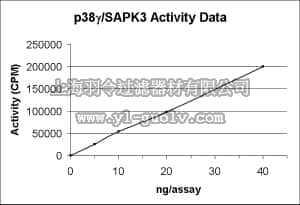 merck millipore,默克密理博,14-246,p38γ/SAPK3 Protein, active, 10 µg
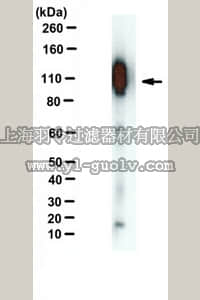 merck millipore,默克密理博,MABN381,Anti-APP-C99 Antibody, clone mC99(1-7)
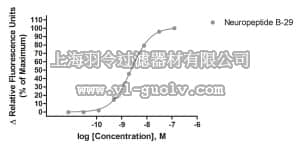 merck millipore,默克密理博,HTS180RTA,Ready-to-Assay™ NPBW1 Neuropeptide B/W Receptor Frozen Cells
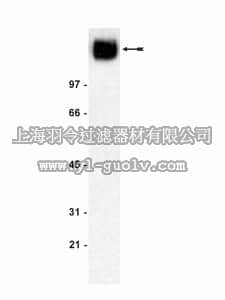 merck millipore,默克密理博,05-593,Anti-α-Dystroglycan Antibody, clone IIH6C4
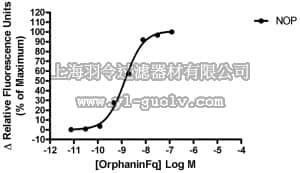 merck millipore,默克密理博,HTS040RTA,Ready-to-Assay™ NOP1 Opioid Receptor Frozen Cells
 merck millipore,默克密理博,06-1103,Anti-Protein patched homolog 2 Antibody