- 当前位置:首页 > >Merck Millipore > 生命科学研究
- 生命科学研究
-
-
merck millipore,默克密理博,ECM671,QCM™ Gelatin Invadopodia Assay (Red)
产品名称:QCM™ Gelatin Invadopodia Assay (Red)
产品型号:ECM671
This QCM Gelatin Invadopodia Assay (Red) provides the reagents necessary for affixing a thin, uniform layer of Cy3-labeled gelatin to a glass culture substrate, allowing for rapid detection of matrix More>>
merck millipore,默克密理博,ECM671,QCM™ Gelatin Invadopodia Assay (Red)
- 产品介绍
重要规格表
主要应用 检测方法 Migration, Invasion Assay Fluorescent 描述 产品目录编号 ECM671 品牌系列 Chemicon®
商名 - Chemicon
- QCM
描述 QCM™ Gelatin Invadopodia Assay (Red) 概述 Read our application note in Nature Methods!
Also available: Cell Comb™ Scratch Assay! Get biochemical data from a scratch assay!
Invasion of cells through layers of extracellular matrix is a key step in tumor metastasis, inflammation, and development. The process of invasion involves several stages, including adhesion to the matrix, degradation of proximal matrix molecules, extension and traction of the cell on the newly revealed matrix, and movement of the cell body through the resulting gap in the matrix (Friedl and Wolf, 2009). Each of these stages of invasion is executed by a suite of proteins, including proteases, integrins, GTPases, kinases, and cytoskeleton-interacting proteins.
Classical methods for analyzing cellular invasion involve application of cells to one side of a layer of gelled matrix molecules and quantifying the relative number of cells that have traversed the layer. Such methods are extremely useful for analyzing invasion at the cell population level, but analysis of the subcellular events mediating the stages of invasion require techniques with higher resolution. The method that has been most informative for pinpointing regions of the cell that initiate invasion involve plating cells on a culture surface coated with a thin layer of fluorescently labeled matrix, and visualizing regions where the cell has degraded the matrix to create an area devoid of fluorescence (Chen et al., 1984). Such assays have revealed that invasive cells extend small localized protrusions that preferentially degrade the matrix. These protrusions are termed invadopodia in cancerous cells, and podosomes in non-malignant cells such as macrophages (Ayala et al., 2006). Many molecules orchestrate the formation and function of invadopodia; a few of the key molecular events include Src phosphorylation of scaffolding protein Tks5 (Seals et al., 2005), N-WASP activation and cortactin regulation of the Arp2/3 complex to induce actin polymerization (Yamaguchi et al., 2005; Weaver, 2006), and generation of reactive oxygen species by NADPH oxidases (Diaz et al., 2009).
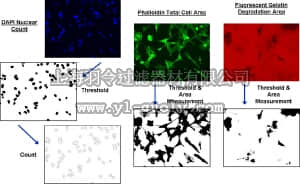
EMD Millipore’s QCM™ Gelatin Invadopodia Assays provide optimized materials and protocols to enable reproducible analysis of invadopodia in invasive tumor cells. All of the components necessary for affixing a thin film of fluorescent matrix to glass culture surfaces are provided. In addition, compatible reagents are provided for co-localizing the actin cytoskeleton and nuclei with invadopodial degradation sites. This assay may be used for assessing activity of inhibitors and promoters of invadopodia formation and function. Finally, different cell types as well as individual cells in heterogeneous populations may be analyzed for invasive potential with the QCM™ Gelatin Invadopodia Assay.产品信息 部件 - FITC-Phalloidin: One vial containing 20 µg
- Cy3-Gelatin, 4X: One vial containing 0.5 mL
- Unlabeled Gelatin, 4X: One vial containing 2 mL
- DAPI: One vial containing 100 µL at 100 µg/mL in water
- Poly-L-Lysine, 2X: One vial containing 5 mL
- Glutaraldehyde, 16X: One vial containing 1 mL
检测方法 Fluorescent 应用 应用 This QCM Gelatin Invadopodia Assay (Red) provides the reagents necessary for affixing a thin, uniform layer of Cy3-labeled gelatin to a glass culture substrate, allowing for rapid detection of matrix degradation. 主要应用 - Migration
- Invasion Assay
应用说明 The EMD Millipore QCM™ Gelatin Invadopodia Assay (Red) provides the reagents necessary for affixing a thin, uniform layer of Cy3-labeled gelatin to a glass culture substrate, allowing for rapid detection of matrix degradation (Artym et al., 2009, Xu et al., 2009). A poly-L-lysine coating is first adsorbed to the glass substratum. The substrate is then treated with a dilute glutaraldehyde solution to bi-functionally “activate” the surface for further protein binding. Subsequent incubation of the surface with fluorescent gelatin allows covalent coupling between the poly-L-lysine and gelatin via reactive aldehyde (-CHO) groups. The fluorescently-coated glass is now prepared for cell culture by disinfection with 70% ethanol, followed by quenching of free aldehydes with amino acid-containing growth medium. Upon completion of fluorescent substrate preparation, cell types of interest may be seeded onto the gelatin surface for a desired amount of time. Depending on cell type, degradation may occur within a few to several hours. Treatment compounds of interest may also be introduced within the culture period.
With EMD Millipore’s QCM™ Gelatin Invadopodia Assay (Red), degraded areas of gelatin, now devoid of fluorescence, may be microscopically visualized and quantified using image analysis software algorithms. The assay also provides fluorescent FITC-phalloidin and DAPI, for visualization of cytoskeletal F-actin and nuclei, respectively, to allow co-localization of degradation with cellular features. Potential activators or inhibitors of invadopodia formation may be investigated for their influence on the degree and frequency of matrix degradation, and the assay may be further combined with immunocytochemical staining for other molecules of interest in pathway studies.产品使用声明 使用声明 - Unless otherwise stated in our catalog or other company documentation accompanying the product(s), our products are intended for research use only and are not to be used for any other purpose, which includes but is not limited to, unauthorized commercial uses, in vitro diagnostic uses, ex vivo or in vivo therapeutic uses or any type of consumption or application to humans or animals.
储存和货运信息 存储条件 Store Cy3-Gelatin, Unlabeled Gelatin, Poly-L-Lysine and DAPI at 2-8°C. Store Glutaraldehyde and FITC-Phalloidin at -20°C. Use all reagents within 4 months from date of receipt. 包装信息 数量 32 assays (1 kit) 包装 Enough Reagents for 4 x 8-well Chamber Slides (32 assays)
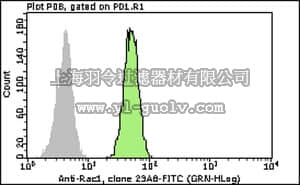
上一件merck millipore产品:merck millipore,默克密理博,FCMAB330F,Milli-Mark™ Anti-Rac1-FITC Antibody, clone 23A8
下一件merck millipore产品:merck millipore,默克密理博,539229,Anti-Protein Disulfide Isomerase Rabbit pAb
相关产品
 merck millipore,默克密理博,AB5414P,Anti-Taurine Transporter Antibody
merck millipore,默克密理博,PP65-K,Gamma Globulin Rabbit, Crude
 merck millipore,默克密理博,386790,Hydrogen Peroxide - CAS 7722-84-1 - Calbiochem
 merck millipore,默克密理博,FCMAB330F,Milli-Mark™ Anti-Rac1-FITC Antibody, clone 23A8
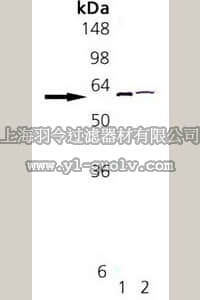 merck millipore,默克密理博,539229,Anti-Protein Disulfide Isomerase Rabbit pAb
merck millipore,默克密理博,MAB16983,Anti-Integrin α4 Antibody, clone P1H4
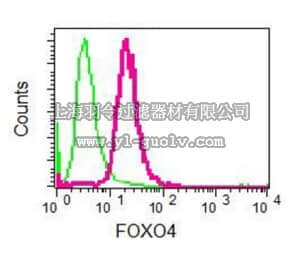 merck millipore,默克密理博,MABE539,Anti-FOX AntibodyO4, clone EPR5442, rabbit monoclonal