- 当前位置:首页 > >Merck Millipore > 生命科学研究
- 生命科学研究
- 产品介绍
重要规格表
品种反应性 主要应用 宿主 格式 抗体类型 H WB Rb Affinity Purified Polyclonal Antibody 描述 产品目录编号 ABS47 描述 Anti-phospho-SMAD3 (Tyr179) Antibody Alternate Names - mothers against DPP homolog 3
- Mothers against DPP homolog 3
- MAD homolog 3
- MAD, mothers against decapentaplegic homolog 3 (Drosophila)
- mothers against DPP homolog 3 (Drosophila)
- mad homolog JV15-2
- mad protein homolog
- MAD, mothers against decapentaplegic homolog 3
- mothers against decapentaplegic homolog 3
- SMA- and MAD-related protein 3
背景信息 Members of the Smad family of signal transduction molecules are components of a critical intracellular pathway that transmits TGF-β signals from the cell surface into the nucleus. Three distinct classes of Smads have been defined: the receptor-regulated Smads (R-Smads), which include Smad1, 2, 3, 5 and 8, the common-mediator Smad (co-Smad), Smad4, and the antagonistic or inhibitory Smads (I-Smads), Smad6 and 7. Once in the nucleus, Smads can target a variety of DNA binding proteins to regulate transcriptional responses. Following stimulation by TGF-β, Smad2 and Smad3 become phosphorylated at their carboxyl termini (Ser465 and 467 on Smad2; Ser423 and 425 on Smad3) by TGF-β Receptor I. Phosphorylated Smad 2/3 can complex with Smad4, translocate to the nucleus and regulate gene expression. 产品信息 格式 Affinity Purified 控制 - Untreated and TGF Beta-treated HaCat cell lysates.
演示 Purified rabbit polyclonal serum in buffer containing 0.1 M Tris-Glycine (pH 7.4), 150 mM NaCl with 0.5% sodium azide. 应用 应用 Detect phospho-SMAD3 (Tyr179) using this Anti-phospho-SMAD3 (Tyr179) Antibody validated for use in Western Blotting. 主要应用 - Western Blotting
生物信息 免疫原品种 KLH-conjugated linear peptide corresponding to the Linker Region of human SMAD3 phosphorylated at Tyr179.. 表位 Linker region 浓缩 Please refer to the Certificate of Analysis for the lot-specific concentration. 宿主 Rabbit 特异性 This antibody recognizes the Linker region of SMAD3 phosphorylated at Thr179. 品种反应性 Human Species Reactivity Note Demonstrated to react with Human. Predicted to react with Bovine, Rat, Porcine based on 100% sequence homology. Other homologies: Zebrafish (91% sequence homology), Chicken (91% sequence homology) and Xenopus (91% sequence homology). 抗体类型 Polyclonal Antibody Entrez基因编号 - NP_005893
Entrez基因汇总 The protein encoded by this gene belongs to the SMAD, a family of proteins similar to the gene products of the Drosophila gene 'mothers against decapentaplegic' (Mad) and the C. elegans gene Sma. SMAD proteins are signal transducers and transcriptional modulators that mediate multiple signaling pathways. This protein functions as a transcriptional modulator activated by transforming growth factor-beta and is thought to play a role in the regulation of carcinogenesis. 基因符号 - SMAD 3
- JV15-2
- MADH3
- HsT17436
- hMAD-3
- hSMAD3
- DKFZp586N0721
- DKFZp686J10186
- HSPC193
- MGC60396
- OTTHUMP00000164305
- mad3
- Mad3
- Smad3
修改 - Phosphorylation
纯化方法 Affinity purified UniProt编号 - P84022
UniProt汇总 FUCTION: Receptor-regulated SMAD (R-SMAD) that is an intracellular signal transducer and transcriptional modulator activated by TGF-beta (transforming growth factor) and activin type 1 receptor kinases. Binds the TRE element in the promoter region of many genes that are regulated by TGF-beta and, on formation of the SMAD3/SMAD4 complex, activates transcription. Also can form a SMAD3/SMAD4/JUN/FOS complex at the AP-1/SMAD site to regulate TGF-beta-mediated transcription. Has an inhibitory effect on wound healing probably by modulating both growth and migration of primary keratinocytes and by altering the TGF-mediated chemotaxis of monocytes. This effect on wound healing appears to be hormone-sensitive. Regulator of chondrogenesis and osteogenesis and inhibits early healing of bone fractures By similarity. Positively regulates PDPK1 kinase activity by stimulating its dissociation from the 14-3-3 protein YWHAQ which acts as a negative regulator.
SUBUNIT STRUCTURE: Monomer; in the absence of TGF-beta. Homooligomer; in the presence of TGF-beta. Heterotrimer; forms a heterotrimer in the presence of TGF-beta consisting of two molecules of C-terminally phosphorylated SMAD2 or SMAD3 and one of SMAD4 to form the transcriptionally active SMAD2/SMAD3-SMAD4 complex. Interacts with TGFBR1. Part of a complex consisting of AIP1, ACVR2A, ACVR1B and SMAD3. Interacts with AIP1, TGFB1I1, TTRAP, FOXL2, PML, PRDM16, HGS and WWP1. Interacts (via MH2 domain) with CITED2 (via C-terminus) By similarity. Interacts with NEDD4L; the interaction requires TGF-beta stimulation By similarity. Interacts (via the MH2 domain) with ZFYVE9. Interacts with HDAC1, VDR, TGIF and TGIF2, RUNX3, CREBBP, SKOR1, SKOR2, SNON, ATF2, SMURF2 and TGFB1I1. Interacts with DACH1; the interaction inhibits the TGF-beta signaling. Forms a complex with SMAD2 and TRIM33 upon addition of TGF-beta. Found in a complex with SMAD3, RAN and XPO4. Interacts in the complex directly with XPO4. Interacts (via the MH2 domain) with LEMD3; the interaction represses SMAD3 transcriptional activity through preventing the formation of the heteromeric complex with SMAD4 and translocation to the nucleus. Interacts with RBPMS. Interacts (via MH2 domain) with MECOM. Interacts with WWTR1 (via its coiled-coil domain). Interacts (via the linker region) with EP300 (C-terminal); the interaction promotes SMAD3 acetylation and is enhanced by TGF-beta phosphorylation in the C-terminal of SMAD3. This interaction can be blocked by competitive binding of adenovirus oncoprotein E1A to the same C-terminal site on EP300, which then results in partially inhibited SMAD3/SMAD4 transcriptional activity. Interacts with SKI; the interaction represses SMAD3 transcriptional activity. Component of the multimeric complex SMAD3/SMAD4/JUN/FOS which forms at the AP1 promoter site; required for syngernistic transcriptional activity in response to TGF-beta. Interacts (via an N-terminal domain) with JUN (via its basic DNA binding and leucine zipper domains); this interaction is essential for DNA binding and cooperative transcriptional activity in response to TGF-beta. Interacts with PPM1A; the interaction dephosphorylates SMAD3 in the C-terminal SXS motif leading to disruption of the SMAD2/3-SMAD4 complex, nuclear export and termination of TGF-beta signaling. Interacts (dephosphorylated form via the MH1 and MH2 domains) with RANBP3 (via its C-terminal R domain); the interaction results in the export of dephosphorylated SMAD3 out of the nucleus and termination of the TGF-beta signaling. Interacts with MEN1. Interacts with IL1F7. Interaction with CSNK1G2. Interacts with PDPK1 (via PH domain).
SUBCELLULAR LOCATION: Cytoplasm. Nucleus. Note: Cytoplasmic and nuclear in the absence of TGF-beta. On TGF-beta stimulation, migrates to the nucleus when complexed with SMAD4. Through the action of the phosphatase PPM1A, released from the SMAD2/SMAD4 complex, and exported out of the nucleus by interaction with RANBP1. Co-localizes with LEMD3 at the nucleus inner membrane. MAPK-mediated phosphorylation appears to have no effect on nuclear import. PDPK1 prevents its nuclear translocation in response to TGF-beta.
DOMAIN: The MH1 domain is required for DNA binding. Also binds zinc ions which are necessary for the DNA binding.
The MH2 domain is required for both homomeric and heteromeric interactions and for transcriptional regulation. Sufficient for nuclear import. Ref.22
The linker region is required for the TGFbeta-mediated transcriptional activity and acts synergistically with the MH2 domain. Ref.22
PTM: Phosphorylated on serine and threonine residues. Enhanced phosphorylation in the linker region on Thr-179, Ser-204 and Ser-208 on EGF AND TGF-beta treatment. Ser-208 is the main site of MAPK-mediated phosphorylation. CDK-mediated phosphorylation occurs in a cell-cycle dependent manner and inhibits both the transcriptional activity and antiproliferative functions of SMAD3. This phosphorylation is inhibited by flavopiridol. Maximum phosphorylation at the G1/S junction. Also phosphorylated on serine residues in the C-terminal SXS motif by TGFBR1 and ACVR1. TGFBR1-mediated phosphorylation at these C-terminal sites is required for interaction with SMAD4, nuclear location and transactivational activity, and appears to be a prerequisite for the TGF-beta mediated phosphorylation in the linker region. Dephosphorylated in the C-terminal SXS motif by PPM1A. This dephosphorylation disrupts the interaction with SMAD4, promotes nuclear export and terminates TGF-beta-mediated signaling. Phosphorylation at Ser-418 by CSNK1G2/CK1 promotes ligand-dependent ubiquitination and subsequent proteasome degradation, thus inhibiting SMAD3-mediated TGF-beta responses. Phosphorylated by PDPK1.
Acetylation in the nucleus by EP300 in the MH2 domain regulates positively its transcriptional activity and is enhanced by TGF-beta.
Ubiquitinated. Ref.38
INVOLVEMENT IN DISEASE: Defects in SMAD3 may be a cause of colorectal cancer (CRC) [MIM:114500].
Defects in SMAD3 are the cause of Loeys-Dietz syndrome type 1C (LDS1C) [MIM:613795]. An aortic aneurysm syndrome with widespread systemic involvement. The disorder is characterized by the triad of arterial tortuosity and aneurysms, hypertelorism, and bifid uvula or cleft palate. Patients with LDS1C also manifest early-onset osteoarthritis. They lack craniosynostosis and mental retardation. Note=SMAD3 mutations have been reported to be also associated with thoracic aortic aneurysms and dissection (TAAD) (Ref.52). This phenotype is distinguised from LDS1C by having aneurysms restricted to thoracic aorta. As individuals carrying these mutations also exhibit aneurysms of other arteries, including abdominal aorta, iliac, and/or intracranial arteries (Ref.52), they have been classified as LDS1C by the OMIM resource.
SEQUENCE SIMILARITIES: Belongs to the dwarfin/SMAD family.
Contains 1 MH1 (MAD homology 1) domain.
Contains 1 MH2 (MAD homology 2) domain.产品使用声明 质量保证 Evaluated by Western Blotting in untreated and TGF Beta-treated HaCat cell lysates.
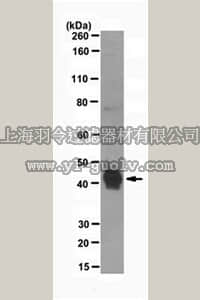
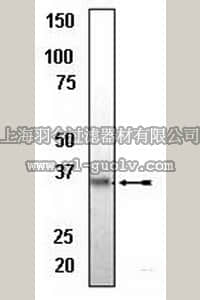
Western Blotting Analysis: A 1:1,000 dilution of this antibody detected SMAD3 in 10 mg of untreated and TGF Beta-treated HaCat cell lysates.使用声明 - Unless otherwise stated in our catalog or other company documentation accompanying the product(s), our products are intended for research use only and are not to be used for any other purpose, which includes but is not limited to, unauthorized commercial uses, in vitro diagnostic uses, ex vivo or in vivo therapeutic uses or any type of consumption or application to humans or animals.
储存和货运信息 存储条件 Stable for 1 year at 2-8º from date of receipt. 包装信息 数量 100 µL
上一件merck millipore产品:merck millipore,默克密理博,14-773M,BTK (E41K) Protein, active, 250 µg
下一件merck millipore产品:merck millipore,默克密理博,AG910-1MG,β Amyloid 1-40, aβ, ultra pure, TFA, recombinant human
相关产品
 merck millipore,默克密理博,MAB8705-KC,Mouse Anti-Dengue Complex, clone D3-2H2-9-21 (10mg) KC
 merck millipore,默克密理博,MAB1222,Anti-Tryptase Antibody, Mast Cell, clone G3

 merck millipore,默克密理博,ABE532,Anti-acetyl Histone H4 (Lys12) Antibody
 merck millipore,默克密理博,14-773M,BTK (E41K) Protein, active, 250 µg
merck millipore,默克密理博,AG910-1MG,β Amyloid 1-40, aβ, ultra pure, TFA, recombinant human
merck millipore,默克密理博,AP101M,Rabbit Anti-Human IgG Antibody, AMCA conjugate
 merck millipore,默克密理博,04-440,Anti-Caspase-3 (Pro) Antibody, rabbit monoclonal
 merck millipore,默克密理博,375645,HePTP Inhibitor, ML119 - Calbiochem