


- 当前位置:首页 > >Merck Millipore > 生命科学研究
- 生命科学研究
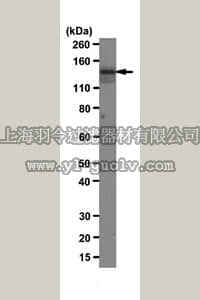
- 产品介绍
重要规格表
品种反应性 主要应用 宿主 格式 抗体类型 M, H ICC, WB M Purified Monoclonal Antibody 描述 产品目录编号 05-1911 描述 Anti-SHIP Antibody, clone P1C1 Alternate Names - SH2 domain-containing inositol-5'-phosphatase 1
- inositol polyphosphate-5-phosphatase, 145kDa
- SH2 containing inositol phosphatase
- signaling inositol polyphosphate 5 phosphatase SIP-145
- Inositol polyphosphate-5-phosphatase of 145 kDa
- inositol polyphosphate-5-phosphatase, 145kD
- SH2 domain-containing inositol phosphatase 1
- SH2 containing inositol phosphatase, isoform b
背景信息 Expressed only in hematopoietic cells, Src homology (SH)-2 containing Inositol phosphatase (SHIP) is a member of the Inositol polyphosphatase-5-phosphatase (INPP5) family characterized as containing several protein interaction domains that include an Inositol phosphatase domain, a SH2 domain, and a proline-rich domain. SHIP hydrolyzes the phosphatidylinositol 3-kinase product phosphatidylinositol-3,4,5-triphosphatase, a requirement of activation for several enzymes containing pleckstrin homology domains. The movement of this protein from cytosol to the plasma membrane is regulated by tyrosine phosphorylation as a response to various activations by cytokines and T and B cell receptors. SHIP is a necessary negative regulator, moderating the balance of both the positive and negative signals in myeloid cells and lymphocytes. There are multiple forms of SHIP, which have been shown to result from the truncation of the C-terminus. 产品信息 格式 Purified 控制 - THP-1 cell lysate
演示 Purified mouse monoclonal IgG1κ in buffer containing 0.1 M Tris-Glycine (pH 7.4, 150 mM NaCl) with 0.05% sodium azide. 应用 应用 This SHIP antibody is validated for use in WB, ICC & IP for the detection of the SHIP protein. 主要应用 - Immunocytochemistry
- Western Blotting
应用说明 Immunoprecipitation Analysis: A previous lot was used by an independent laboratory in IP. (Lucas, D., et al. (1999). Blood. 93(6):1922-1933.) 生物信息 免疫原品种 KLH-conjugated linear peptide corresponding to human SHIP. 表位 Unknown 克隆 P1C1 浓缩 Please refer to the Certificate of Analysis for the lot-specific concentration. 宿主 Mouse 特异性 This antibody recognizes SHIP. 同种型 IgG1κ 品种反应性 MouseHuman Species Reactivity Note Demonstrated to react with human. Predicted to react with mouse based on 100% sequence homology. 抗体类型 Monoclonal Antibody Entrez基因编号 - NP_001017915.1
Entrez基因汇总 This gene is a member of the inositol polyphosphate-5-phosphatase (INPP5) family and encodes a protein with an N-terminal SH2 domain, an inositol phosphatase domain, and two C-terminal protein interaction domains. Expression of this protein is restricted to hematopoietic cells where its movement from the cytosol to the plasma membrane is mediated by tyrosine phosphorylation. At the plasma membrane, the protein hydrolyzes the 5' phosphate from phosphatidylinositol (3,4,5)-trisphosphate and inositol-1, 3, 4, 5-tetrakisphosphate, thereby affecting multiple signaling pathways. Overall, the protein functions as a negative regulator of myeloid cell proliferation and survival. Alternate transcriptional splice variants, encoding different isoforms, have been characterized. [provided by RefSeq]. 基因符号 - SHIP1
- INPP5D
- hp51CN
- p150Ship
- SHIP
- SIP-145
- SHIP-1
纯化方法 Protein G purfied UniProt编号 - Q92835
UniProt汇总 FUNCTION: Phosphatidylinositol (PtdIns) phosphatase that specifically hydrolyzes the 5-phosphate of phosphatidylinositol-3,4,5-trisphosphate (PtdIns(3,4,5)P3) to produce PtdIns(3,4)P2, thereby negatively regulating the PI3K (phosphoinositide 3-kinase) pathways. Acts as a negative regulator of B-cell antigen receptor signaling. Mediates signaling from the FC-gamma-RIIB receptor (FCGR2B), playing a central role in terminating signal transduction from activating immune/hematopoietic cell receptor systems. Acts as a negative regulator of myeloid cell proliferation/survival and chemotaxis, mast cell degranulation, immune cells homeostasis, integrin alpha-IIb/beta-3 signaling in platelets and JNK signaling in B-cells. Regulates proliferation of osteoclast precursors, macrophage programming, phagocytosis and activation and is required for endotoxin tolerance. Involved in the control of cell-cell junctions, CD32a signaling in neutrophils and modulation of EGF-induced phospholipase C activity. Key regulator of neutrophil migration, by governing the formation of the leading edge and polarization required for chemotaxis. Modulates FCGR3/CD16-mediated cytotoxicity in NK cells. Mediates the activin/TGF-beta-induced apoptosis through its Smad-dependent expression. May also hydrolyze PtdIns(1,3,4,5)P4, and could thus affect the levels of the higher inositol polyphosphates like InsP6.
CATALYTIC ACTIVITY: Phosphatidylinositol 3,4,5-trisphosphate + H2O = phosphatidylinositol 3,4-bisphosphate + phosphate.
ENZYME REGULATION: Activated upon translocation to the sites of synthesis of PtdIns(3,4,5)P3 in the membrane By similarity.
SUBUNIT STRUCTURE: Interacts with tyrosine phosphorylated forms of SHC1, DOK1, DOK3, PTPN11/SHP-2, SLAMF1/CD150. Interacts with PTPN11 in response to IL-3. Interacts with receptors EPOR, MS4A2/FCER1B and FCER1G, FCGR2A, FCGR2B and FCGR3. Interacts with GRB2 and PLCG1. Interacts with tyrosine kinases SRC and TEC. Interacts with FCGR2A, leading to regulate gene expression during the phagocytic process. Interacts with c-Met/MET By similarity.
SUBCELLULAR LOCATION: Cytoplasm. Membrane; Peripheral membrane protein. Note: Translocates to the plasma membrane when activated, translocation is probably due to different mechanisms depending on the stimulus and cell type. Partly translocated via its SH2 domain which mediates interaction with tyrosine phosphorylated receptors such as the FC-gamma-RIIB receptor (FCGR2B) or CD16/FCGR3. Tyrosine phosphorylation may also participate to membrane localization By similarity.
TISSUE SPECIFICITY: Specifically expressed in immune and hematopoietic cells. Expressed in bone marrow and blood cells. Levels vary considerably within this compartment. Present in at least 74% of immature CD34+ cells, whereas within the more mature population of CD33+ cells, it is present in only 10% of cells. Present in the majority of T-cells, while it is present in a minority of B-cells (at protein level). Ref.1 Ref.2 Ref.5 Ref.4
DOMAIN: The SH2 domain interacts with tyrosine phosphorylated forms of proteins such as SHC1 or PTPN11/SHP-2. It competes with that of GRB2 for binding to phosphorylated SHC1 to inhibit the Ras pathway. It is also required for tyrosine phosphorylation by similarity.
The NPXY sequence motif found in many tyrosine-phosphorylated proteins is required for the specific binding of the PID domain by similarity.
PTM: Tyrosine phosphorylated by the members of the SRC family after exposure to a diverse array of extracellular stimuli such as cytokines, growth factors, antibodies, chemokines, integrin ligands and hypertonic and oxidative stress. Phosphorylated upon IgG receptor FCGR2B-binding.
SEQUENCE SIMILARITIES: Belongs to the inositol-1,4,5-trisphosphate 5-phosphatase family.
Contains 1 SH2 domain.产品使用声明 质量保证 Evaluated by Western Blot in THP-1 cell lysate.
Western Blot Analysis: 1 µg/mL of this antibody detected SHIP on 10 µg of THP-1 cell lysate.使用声明 - Unless otherwise stated in our catalog or other company documentation accompanying the product(s), our products are intended for research use only and are not to be used for any other purpose, which includes but is not limited to, unauthorized commercial uses, in vitro diagnostic uses, ex vivo or in vivo therapeutic uses or any type of consumption or application to humans or animals.
储存和货运信息 存储条件 Stable for 1 year at 2-8°C from date of receipt. 包装信息 数量 100 µg
上一件merck millipore产品:merck millipore,默克密理博,HTS042M,ChemiScreen™ BLT1 Membrane Preparation
下一件merck millipore产品:merck millipore,默克密理博,SCR081,MilliTrace Constitutive GFP Reporter Mouse Cortical Neural Stem Cell Kit
相关产品
 merck millipore,默克密理博,AB5028,Anti-Endorphin β Antibody
 merck millipore,默克密理博,GF425,HumanKine IL-28A, Human Recombinant Xeno-Free
 merck millipore,默克密理博,07-733,Anti-phospho-Paxillin (Tyr118) Antibody
 merck millipore,默克密理博,ABN474,Anti-EPM2A Antibody
 merck millipore,默克密理博,HTS042M,ChemiScreen™ BLT1 Membrane Preparation

 merck millipore,默克密理博,496100,Omeprazole - CAS 73590-58-6 - Calbiochem
 merck millipore,默克密理博,0500-0240,Guava Express Software
 merck millipore,默克密理博,MABD187,Anti-Smad7, clone EPR622, Rabbit Monoclonal Antibody
 merck millipore,默克密理博,05-756,Anti-Calsenilin/DREAM Antibody, clone 40A5