


- 当前位置:首页 > >Merck Millipore > 生命科学研究
- 生命科学研究

- 产品介绍
重要规格表
品种反应性 主要应用 宿主 格式 抗体类型 Xn, H, Ht, Mk WB, ICC, IHC M Culture Supernatant Monoclonal Antibody 描述 产品目录编号 MAB3211 Replaces MABE481 品牌系列 Chemicon®
商名 - Chemicon
描述 Anti-Lamin A/C Antibody, clone JoL2 产品信息 格式 Culture Supernatant 控制 - Mammalian Cardiac tissue
演示 UnPurified mouse tissue culture supernatant containing 0.2M Tris/HCl pH 7.4 and 5-10% fetal calf Serum with 0.09% sodium azide as a preservative 应用 应用 Anti-Lamin A/C Antibody, clone JoL2 is an antibody against Lamin A/C for use in IC, IF, IH, IP & WB. 主要应用 - Western Blotting
- Immunocytochemistry
- Immunohistochemistry
应用说明 Immunohistochemistry: overnight incubation is recommended. Frozen tissue sections Neat-1:5; paraffin embedded tissue sections 1:30-1:50 (requires pretreatment with trypsin prior to staining)
Immunoprecipitation: Neat
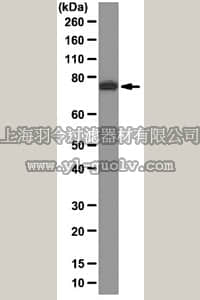
Western Blotting: 1:150-1:200
Optimal working dilutions must be determined by the end user.生物信息 免疫原品种 Recombinant human lamin A 克隆 JoL2 宿主 Mouse 特异性 Recognizes human lamins A and C. The antibody reacts with both recombinant and native lamin A and C. The antibody has been shown to bind to an epitope between amino acids 464-572. 同种型 Ig 品种反应性 XenopusHumanHamsterMonkey 抗体类型 Monoclonal Antibody Entrez基因编号 - NM_170708.2
- NM_005572.3
- NM_170707.2
Entrez基因汇总 The nuclear lamina consists of a two-dimensional matrix of proteins located next to the inner nuclear membrane. The lamin family of proteins make up the matrix and are highly conserved in evolution. During mitosis, the lamina matrix is reversibly disassembled as the lamin proteins are phosphorylated. Lamin proteins are thought to be involved in nuclear stability, chromatin structure and gene expression. Vertebrate lamins consist of two types, A and B. Through alternate splicing, this gene encodes three type A lamin isoforms. Mutations in this gene lead to several diseases: Emery-Dreifuss muscular dystrophy, familial partial lipodystrophy, limb girdle muscular dystrophy, dilated cardiomyopathy, Charcot-Marie-Tooth disease, and Hutchinson-Gilford progeria syndrome. 基因符号 - CDDC
- LMNA
- HGPS
- EMD2
- FPLD
- CDCD1
- LDP1
- LGMD1B
- IDC
- CMT2B1
- FPL
- LMNC
- PRO1
- Lamin-A/C
- LMN1
- CMD1A
- LFP
纯化方法 Unpurified UniProt编号 - P02545
UniProt汇总 FUNCTION: SwissProt: P02545 # Lamins are components of the nuclear lamina, a fibrous layer on the nucleoplasmic side of the inner nuclear membrane, which is thought to provide a framework for the nuclear envelope and may also interact with chromatin. Lamin A and C are present in equal amounts in the lamina of mammals.
SIZE: 664 amino acids; 74139 Da
SUBUNIT: Homodimer of lamin A and lamin C. Interacts with lamin- associated polypeptides IA, IB and TMPO-alpha, RB1 and with emerin. Proteolytically processed isoform A interacts with NARF.
SUBCELLULAR LOCATION: Nucleus.
PTM: Increased phosphorylation of the lamins occurs before envelope disintegration and probably plays a role in regulating lamin associations. & The C-terminal 18 residues are removed by proteolytic cleavage in isoform A. Proteolytic cleavage requires prior farnesylation and absence of farnesylation blocks cleavage (By similarity).
DISEASE: SwissProt: P02545 # Defects in LMNA are a cause of Emery-Dreifuss muscular dystrophy type 2 (EDMD2) [MIM:181350]. EDMD2 is an autosomal dominant disorder characterized by slowly progressive muscle wasting and weakness, early contractures of the elbows Achilles tendons and spine, and cardiomyopathy associated with cardiac conduction defects. & Defects in LMNA are a cause of Emery-Dreifuss muscular dystrophy type 3 (EDMD3) [MIM:604929]. EDMD3 is an autosomal recessive disorder characterized by early contractures, muscle wasting and weakness and cardiomyopathy. & Defects in LMNA are a cause of dilated cardiomyopathy 1A (CMD1A) [MIM:115200]. Dilated cardiomyopathy, a disorder characterized by cardiac dilation and reduced systolic function, represents an outcome of a heterogeneous group of inherited and acquired disorders. & Defects in LMNA are a cause of CMD1A with quadriceps myopathy [MIM:607920]. Inheritance is autosomal dominant and the phenotype severe. & Defects in LMNA are a cause of generalized lipoatrophy associated with diabetes, hepatic steatosis, hypertrophic cardiomyopathy and leukomelanodermic papules (LDHCP) [MIM:608056]. LDHCP is a disorder characterized by acquired generalized lipoatrophy with metabolic alterations, massive liver steatosis, distinctive cutaneous manifestations, and cardiac abnormalities involving both endocardium and myocardium. & Defects in LMNA are a cause of familial partial lipodystrophy (FPLD) [MIM:151660]; also known as familial partial lipodystrophy Dunnigan type. FPLD is an autosomal dominant disorder characterized by marked loss of subcutaneous adipose tissue from the extremities and trunk but by excess fat deposition in the head and neck. Frequently associated with profound insulin resistance, dyslipidemia, and diabetes. & Defects in LMNA are the cause of limb-girdle muscular dystrophy type 1B (LGMD1B) [MIM:159001]. LGMD1B is an autosomal dominantly inherited slowly progressive limb girdle muscular dystrophy, with age-related atrioventricular cardiac conduction disturbances and the absence of early contractures. & Defects in LMNA are the cause of Charcot-Marie-Tooth disease type 2B1 (CMT2B1) [MIM:605588]. CMT2B1 is a form of Charcot-Marie-Tooth disease, the most common inherited disorder of the peripheral nervous system. Charcot-Marie-Tooth disease is classified in two main groups on the basis of electrophysiologic properties and histopathology: primary peripheral demyelinating neuropathy or CMT1, and primary peripheral axonal neuropathy or CMT2. Neuropathies of the CMT2 group are characterized by signs of axonal regeneration in the absence of obvious myelin alterations, normal or slightly reduced nerve conduction velocities, and progressive distal muscle weakness and atrophy. CMT2B1 inheritance is autosomal recessive. & Defects in LMNA are the cause of Hutchinson-Gilford progeria syndrome (HGPS) [MIM:176670]. HGPS is a rare genetic disorder characterized by features reminiscent of marked premature aging. & Defects in LMNA are a cause of familial atrial fibrillation (ATFB) [MIM:607554]. Atrial fibrillation is a cardiac arrhythmia characterized by rapid and irregular activation of the atrium. It causes thromboembolism, tachycardia-mediated cardiomyopathy and heart failure. & Defects in LMNA are a cause of Werner syndrome (WRN) [MIM:277700]. WRN is an autosomal, recessively inherited, segmental progeroid syndrome, in which multiple aspects (or segments) of aging phenotypes seem to be entailed. The features of Werner syndrome are scleroderma-like skin changes, especially in the extremities, cataract, subcutaneous calcification, premature arteriosclerosis, diabetes mellitus, and a wizened and prematurely aged facies. & Defects in LMNA are the cause of mandibuloacral dysplasia with type A lipodystrophy (MADA) [MIM:248370]. Mandibuloacral dysplasia (MAD) is a rare autosomal recessive disorder characterized by mandibular and clavicular hypoplasia, acroosteolysis, delayed closure of the cranial suture, joint contractures, and types A or B patterns of lipodystrophy. Type A lipodystrophy observed in MADA, is characterized by fat loss restricted to the extremities. & Defects in LMNA are a cause of lethal tight skin contracture syndrome [MIM:275210]; also called restrictive dermopathy (RD). Lethal tight skin contracture syndrome is a rare disorder mainly characterized by intrauterine growth retardation, tight and rigid skin with erosions, prominent superficial vasculature and epidermal hyperkeratosis, facial features (small mouth, small pinched nose and micrognathia), sparse/absent eyelashes and eyebrows, mineralization defects of the skull, thin dysplastic clavicles, pulmonary hypoplasia, multiple joint contractures and an early neonatal lethal course. Liveborn children usually die within the first week of life. The overall prevalence of consanguineous cases suggested an autosomal recessive inheritance.
SIMILARITY: SwissProt: P02545 ## Belongs to the intermediate filament family.
MISCELLANEOUS: There are three types of lamins in human cells: A, B, and C. & The structural integrity of the lamina is strictly controlled by the cell cycle, as seen by the disintegration and formation of the nuclear envelope in prophase and telophase, respectively.产品使用声明 使用声明 - Unless otherwise stated in our catalog or other company documentation accompanying the product(s), our products are intended for research use only and are not to be used for any other purpose, which includes but is not limited to, unauthorized commercial uses, in vitro diagnostic uses, ex vivo or in vivo therapeutic uses or any type of consumption or application to humans or animals.
储存和货运信息 存储条件 Maintain for 1 year at -20°C from date of shipment. Aliquot to avoid repeated freezing and thawing. For maximum recovery of product, centrifuge the original vial after thawing and prior to removing the cap. 包装信息 数量 1 mL
上一件merck millipore产品:merck millipore,默克密理博,553901,Renin, Human Kidney
下一件merck millipore产品:merck millipore,默克密理博,SF-1417,SOX10; Mouse, Cyanine 3 RNA Detection Probe,SmartFlare
相关产品
 merck millipore,默克密理博,480703,Neurodazine - CAS 1135318-08-9 - Calbiochem
 merck millipore,默克密理博,09-862,Anti-Histone H2A.Z Antibody
 merck millipore,默克密理博,616404,Tpl2 Kinase Inhibitor II - CAS 1186649-59-1 - Calbiochem
 merck millipore,默克密理博,361507,Glycogen, Molecular Biology Grade, Mussel - CAS 9005-79-2 - Calbiochem
 merck millipore,默克密理博,553901,Renin, Human Kidney
 merck millipore,默克密理博,SF-1417,SOX10; Mouse, Cyanine 3 RNA Detection Probe,SmartFlare
 merck millipore,默克密理博,06-1076,Anti-IL-22 Antibody
merck millipore,默克密理博,5161,Penicillin G, Potassium Salt - CAS 113-98-4 - Calbiochem

 merck millipore,默克密理博,MABS12,Anti-GRK6 Antibody, clone 4B11.2