


- 当前位置:首页 > >Merck Millipore > 生命科学研究
- 生命科学研究
-
-
merck millipore,默克密理博,ABE42,Anti-TAF(II)250 Antibody
产品名称:Anti-TAF(II)250 Antibody
产品型号:ABE42
Use Anti-TAF(II)250 Antibody (rabbit polyclonal antibody) validated in WB to detect TAF(II)250 also known as Transcription initiation factor TFIID subunit 1, Cell cycle gene 1 protein, TBP-associated More>>
merck millipore,默克密理博,ABE42,Anti-TAF(II)250 Antibody
- 产品介绍
重要规格表
品种反应性 主要应用 宿主 格式 抗体类型 Ca, H, M, R, B, Eq WB Rb Affinity Purified Polyclonal Antibody 描述 产品目录编号 ABE42 描述 Anti-TAF(II)250 Antibody Alternate Names - TAFII250
- Transcription initiation factor TFIID subunit 1
- Cell cycle gene 1 protein
- TBP-associated factor 250 kDa
- p250
- Transcription initiation factor TFIID 250 kDa subunit
- TAF(II)250
- TAFII-250
背景信息 TAF(II)250, also referred to as TAF1, is an N-terminal kinase and the largest subunit of the human transcription factor TFIID. TAF(II)250 includes serine/threonine kinase domain that has the ability to transphosphorylate and autophosphorylate the basal factor TFIIF large subunit. TAF(II)250 has been shown to form a complex with B-Myb which activated Myb responsive promoters and plays a role in cell cycle regulation. TAF(II)250 is also important in the preservation of Mdm2 phosphorylation and function, which negatively regulates the p53 tumor suppressor protein. 产品信息 格式 Affinity Purified 控制 - HepG2 cell lysate
演示 Purified rabbit polyclonal in buffer containing 0.1 M Tris-Glycine (pH 7.4), 150 mM NaCl with 0.05% sodium azide. 应用 应用 Use Anti-TAF(II)250 Antibody (rabbit polyclonal antibody) validated in WB to detect TAF(II)250 also known as Transcription initiation factor TFIID subunit 1, Cell cycle gene 1 protein, TBP-associated factor 250 kDa. 主要应用 - Western Blotting
生物信息 免疫原品种 KLH-conjugated linear peptide corresponding to human TAF(II)250 at the protein kinase 2 domain. 表位 Protein kinase 2 domain 浓缩 Please refer to the Certificate of Analysis for the lot-specific concentration. 宿主 Rabbit 特异性 This antibody recognizes TAF(II)250 at the protein kinase 2 domain. 品种反应性 CanineHumanMouseRatBovineHorse Species Reactivity Note Demonstrated to react with Human. Predicted to react with Mouse, Rat, Bovine, Equine, and Canine based on 100% sequence homology. 抗体类型 Polyclonal Antibody Entrez基因编号 - NP_004597
Entrez基因汇总 Initiation of transcription by RNA polymerase II requires the activities of more than 70 polypeptides. The protein that coordinates these activities is the basal transcription factor TFIID, which binds to the core promoter to position the polymerase properly, serves as the scaffold for assembly of the remainder of the transcription complex, and acts as a channel for regulatory signals. TFIID is composed of the TATA-binding protein (TBP) and a group of evolutionarily conserved proteins known as TBP-associated factors or TAFs. TAFs may participate in basal transcription, serve as coactivators, function in promoter recognition or modify general transcription factors (GTFs) to facilitate complex assembly and transcription initiation. This gene encodes the largest subunit of TFIID. This subunit binds to core promoter sequences encompassing the transcription start site. It also binds to activators and other transcriptional regulators, and these interactions affect the rate of transcription initiation. This subunit contains two independent protein kinase domains at the N and C-terminals, but also possesses acetyltransferase activity and can act as a ubiquitin-activating/conjugating enzyme. This gene is part of a complex transcriptional unit (TAF1/DYT3), wherein some products share exons with TAF1 as well as additional exons downstream.[provided by RefSeq]. 基因符号 - TAF2A
- TAF1
- BA2R
- CCG1
- CCGS
纯化方法 Affinity purified UniProt编号 - P21675
UniProt汇总 FUNCTION: Largest component and core scaffold of the TFIID basal transcription factor complex. Contains novel N- and C-terminal Ser/Thr kinase domains which can autophosphorylate or transphosphorylate other transcription factors. Phosphorylates TP53 on 'Thr-55' which leads to MDM2-mediated degradation of TP53. Phosphorylates GTF2A1 and GTF2F1 on Ser residues. Possesses DNA-binding activity. Essential for progression of the G1 phase of the cell cycle. CATALYTIC ACTIVITY: ATP + a protein = ADP + a phosphoprotein.
COFACTOR: Magnesium.
ENZYME REGULATION: Autophosphorylates on Ser residues. Inhibited by retinoblastoma tumor suppressor protein, RB1.
SUBUNIT STRUCTURE: TAF1 is the largest component of transcription factor TFIID that is composed of TBP and a variety of TBP-associated factors. TAF1, when part of the TFIID complex, interacts with C-terminus of TP53. Component of some MLL1/MLL complex, at least composed of the core components MLL, ASH2L, HCFC1/HCF1, WDR5 and RBBP5, as well as the facultative components C17orf49, CHD8, E2F6, HSP70, IN80C, KIAA1267, LAS1L, MAX, MCRS1, MGA, MYST1/MOF, PELP1, PHF20, PRP31, RING2, RUVB1/TIP49A, RUVB2/TIP49B, SENP3, TAF1, TAF4, TAF6, TAF7, TAF9 and TEX10. RB1 interacts with the N-terminal domain of TAF1. Interacts with ASF1A and ASF1B. Interacts with SV40 Large T antigen.
SUBCELLULAR LOCATION: Nucleus
PTM: Phosphorylated by casein kinase II in vitro.
INVOLVEMENT IN DISEASE: Defects in TAF1 are the cause of dystonia type 3 (DYT3) [MIM:314250]; also called X-linked dystonia-parkinsonism (XDP). DYT3 is a X-linked dystonia-parkinsonism disorder. Dystonia is defined by the presence of sustained involuntary muscle contractions, often leading to abnormal postures. DYT3 is characterized by severe progressive torsion dystonia followed by parkinsonism. Its prevalence is high in the Philippines. DYT3 has a well-defined pathology of extensive neuronal loss and mosaic gliosis in the striatum (caudate nucleus and putamen) which appears to resemble that in Huntington disease.
SEQUENCE SIMILARITIES: Belongs to the TAF1 family.
Contains 2 bromo domains.
Contains 1 HMG box DNA-binding domain.
Contains 2 protein kinase domains.产品使用声明 质量保证 Evaluated by Western Blot in HepG2 cell lysate.
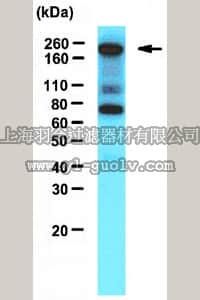
Western Blot Analysis: 1 µg/mL of this antibody detected TAF(II)250 on 10 µg of HepG2 cell lysate.使用声明 - Unless otherwise stated in our catalog or other company documentation accompanying the product(s), our products are intended for research use only and are not to be used for any other purpose, which includes but is not limited to, unauthorized commercial uses, in vitro diagnostic uses, ex vivo or in vivo therapeutic uses or any type of consumption or application to humans or animals.
储存和货运信息 存储条件 Stable for 1 year at 2-8°C from date of receipt. 包装信息 数量 100 µg
上一件merck millipore产品:merck millipore,默克密理博,520222,PPACK, Dihydrochloride - CAS 142036-63-3 - Calbiochem
下一件merck millipore产品:merck millipore,默克密理博,457250,Methylene Blue - CAS 61-73-4 - Calbiochem
相关产品
 merck millipore,默克密理博,341576,Fibrinogen, Human Plasma
 merck millipore,默克密理博,70646,T7Select Human Lung cDNA Library
 merck millipore,默克密理博,05-1336,Anti-phospho-Histone H3 (Ser10) Antibody, clone CMA312
 merck millipore,默克密理博,EZHIL15,Human IL-15 ELISA Kit, EZHIL15
 merck millipore,默克密理博,520222,PPACK, Dihydrochloride - CAS 142036-63-3 - Calbiochem
 merck millipore,默克密理博,457250,Methylene Blue - CAS 61-73-4 - Calbiochem
 merck millipore,默克密理博,AB9451,Anti-Metabotropic Glutamate Receptor 8 Antibody
merck millipore,默克密理博,PSET010R5,Millicell-24 插入式细胞培养板, 聚碳酸酯, 8.0 µm
merck millipore,默克密理博,605190,Thrombin, Human Plasma
 merck millipore,默克密理博,178493,Apoptosis Activator III, Embelin - CAS 550-24-3 - Calbiochem