


- 当前位置:首页 > >Merck Millipore > 生命科学研究
- 生命科学研究
- 产品介绍
重要规格表
主要应用 检测方法 ICC Fluorescent 描述 产品目录编号 17-10224 商名 - Chemicon
- LentiBrite
描述 LentiBrite™ GFP-p62 Lentiviral Biosensor 概述 Read our application note in Nature Methods!
Biosensors can be used to detect the presence/absence of a particular protein as well as the subcellular location of that protein within the live state of a cell. Fluorescent tags are often desired as a means to visualize the protein of interest within a cell by either fluorescent microscopy or time-lapse video capture. Visualizing live cells without disruption allows researchers to observe cellular conditions in real time.
Lentiviral vector systems are a popular research tool used to introduce gene products into cells. Lentiviral transfection has advantages over non-viral methods such as chemical-based transfection including higher-efficiency transfection of dividing and non-dividing cells, long-term stable expression of the transgene, and low immunogenicity.
EMD Millipore is introducing LentiBrite™ Lentiviral Biosensors, a new suite of pre-packaged lentiviral particles encoding important and foundational proteins of autophagy, apoptosis, and cell structure for visualization under different cell/disease states in live cell and in vitro analysis.- Pre-packaged, fluorescently-tagged with GFP & RFP
- Higher efficiency transfection as compared to traditional chemical-based and other non-viral-based transfection methods
- Ability to transfect dividing, non-dividing, and difficult-to-transfect cell types, such as primary cells or stem cells
- Non-disruptive towards cellular function
EMD Millipore’s LentiBrite™ GFP-p62 lentiviral particles provide bright fluorescence and precise localization to enable live-cell analysis of autophagy in difficult-to-transfect cell types.Alternate Names - p62
- Sequestosome-1
- Sequestosome
- Ubiquitin-binding protein p62
- EBI3-associated protein
背景信息 Autophagy, a degradative pathway induced in cells under stress, plays both protective and deleterious roles in many diseases, including cancer, neurodegeneration, and infections. The adaptor protein p62 targets protein aggregates to the autophagosome for degradation via its polyubiquitin-binding domain, and also functions as a scaffold for signaling proteins such as atypical PKCs and mTORC1. In many cell types, p62 ordinarily exists as puncta or speckles, which increase in number and size upon blockade of autophagic flux with lysosome inhibitors. Upon initiation of autophagy, the p62-cargo protein complex binds to LC3 on the autophagosome surface, which results in degradation of this complex. DNA constructs encoding fluorescent proteins fused to p62 are often introduced into cells for monitoring aggregate formation by fluorescence microscopy. EMD Millipore’s LentiBrite™ GFP-p62 lentiviral particles provide bright fluorescence and precise localization to enable live-cell analysis of autophagy in difficult-to-transfect cell types. 产品信息 部件
Multiplicty of Infection (MOI)
MOI = Ratio of # of infectious lentiviral particles (IFU) to # of cells being infected.
Typical MOI values for high transduction efficiency and signal intensity are in the range of 20-40. For this target, some cell types may require lower MOIs (e.g., HT-1080, HeLa, U2OS, human mesenchymal stem cells (HuMSC)), while others may require higher MOIs (e.g., human umbilical vein endothelial cells (HUVEC)).
NOTE: MOI should be titrated and optimized by the end user for each cell type and lentiviral target to achieve desired transduction efficiency and signal intensity.- TagGFP2-p62 Lentivirus:
One vial containing 25 µL of lentiviral particles at a minimum of 3 x 10E8 infectious units (IFU) per mL.
For lot-specific titer information, please see lot specific “Viral Titer” in the product specifications of the datasheet.
Promoter
EF-1 (Elongation Factor-1)
检测方法 Fluorescent 应用 主要应用 - Immunocytochemistry
应用说明 Fluorescence Microscopy
Imaging:
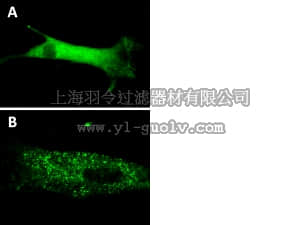
(See Figure 1 in datasheet)
Primary human mesenchymal stem cells (HuMSC) were plated in a chamber slide and transduced with lentiviral particles at an MOI of 40 for 24 hours. After media replacement and 24 hours further incubation, cells were either left in complete media or incubated for 4 hours in EBSS containing a lysosome inhibitor, to induce autophagsome formation and inhibit lysosomal degradation. Cells were fixed with formaldehyde, mounted and imaged by oil immersion wide-field fluorescence microscopy.
The GFP-p62 displays a diffuse cytosolic distribution in fed cells, and a punctate distribution in starved autophagic cells.
Immunocytochemistry Comparison:
(See Figure 2 in datasheet)
Similar to Figure 1 (see datasheet), U2OS cells were plated in a chamber slide and transduced with GFP-p62 lentiviral particles at an MOI of 40 for 24 hours. After 24 hours, media was replaced and cells were then further incubated for 24 hours. The cells were then fixed and stained with a polyclonal antibody against p62 (Cat. No. MABC32), followed by a Cy3-conjugated anti-rabbit IgG. Distribution of the GFP-p62 (green) is similar to that detected by immunocytochemical staining (red).
Hard-to-transfect Cell Types:
(See Figure 3 in datasheet)
Primary cell type HUVEC were plated in a chamber slide and transduced with lentiviral particles at an MOI of 40 for 24 hours. Subsequent treatments for cells left in complete media or cells incubated in EBSS with lysosome inhibitor, were performed as in Figures 1A and 1B (see datasheet)
Time-lapse Imaging:
(See Figure 5 in datasheet and video online)
U2OS cells were plated in coverglass chamber slides and transduced with GFP-p62 lentiviral particles as in Figure 1 (see datasheet). Images were collected every 20 seconds for a total of 32 min. Shown here are 3 sequential frames. The GFP-p62 displays a diffuse cytosolic distribution in fed cells, and a punctate distribution in starved autophagic cells.
For optimal fluorescent visualization, it is recommended to analyze the target expression level within 24-48 hrs after transfection/infection for optimal live cell analysis, as fluorescent intensity may dim over time, especially in difficult-to-transfect cell lines. Infected cells may be frozen down after successful transfection/infection and thawed in culture to retain positive fluorescent expression beyond 24-48 hrs. Length and intensity of fluorescent expression varies between cell lines. Higher MOIs may be required for difficult-to-transfect cell lines.生物信息 基因符号 - OSIL
- p62
- SQSTM1
- ORCA
纯化方法 PEG precipitation UniProt编号 - Q13501
产品使用声明 质量保证 Evaluated by transduction of HT-1080 cells and fluorescent imaging performed for assessment of transduction efficiency. 使用声明 - Unless otherwise stated in our catalog or other company documentation accompanying the product(s), our products are intended for research use only and are not to be used for any other purpose, which includes but is not limited to, unauthorized commercial uses, in vitro diagnostic uses, ex vivo or in vivo therapeutic uses or any type of consumption or application to humans or animals.
- This product contains genetically modified organisms (GMO). Within the EU GMOs are regulated by Directives 2001/18/EC and 2009/41/EC of the European Parliament and of the Council and their national implementation in the member States respectively. This legislation obliges Merck-Millipore to request certain information about you and the establishment where the GMOs are being handled.
储存和货运信息 存储条件 Storage and Handling
Lentivirus is stable for at least 4 months from date of receipt when stored at -80°C. After first thaw, place immediately on ice and freeze in working aliquots at -80°C. Frozen aliquots may be stored for at least 2 months. Further freeze/thaws may result in decreased virus titer and transduction efficiency.
IMPORTANT SAFETY NOTE
Replication-defective lentiviral vectors, such as the 3rd Generation vector provided in this product, are not known to cause any diseases in humans or animals. However, lentiviruses can integrate into the host cell genome and thus pose some risk of insertional mutagenesis. Material is a Risk Group 2 and should be handled under BSL2 controls. A detailed discussion of biosafety of lentiviral vectors is provided in Pauwels, K. et al. (2009). State-of-the-art lentiviral vectors for research use: Risk assessment and biosafety recommendations. Curr. Gene Ther. 9: 459-474.包装信息 数量 1 vial (minimum of 3 x 10E8 IFU/mL)
上一件merck millipore产品:merck millipore,默克密理博,MABE584,Anti-phospho-SMC1 (Ser360), clone EPR4498(2), Rabbit Monoclonal Antibody
下一件merck millipore产品:merck millipore,默克密理博,70003,pBAC™-1 DNA - Novagen
相关产品
 merck millipore,默克密理博,GF165,ANG-2 Protein, Human Recombinant
 merck millipore,默克密理博,71514,Floating Rack, Maxi
merck millipore,默克密理博,111452,邻苯二甲醛
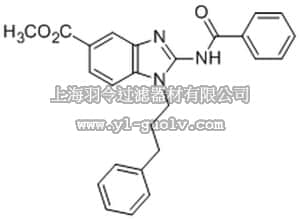 merck millipore,默克密理博,382194,HMTase Inhibitor VI, BRD4770 - Calbiochem
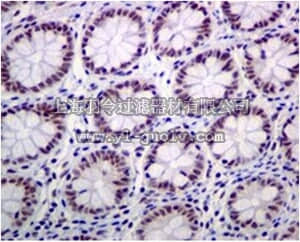
merck millipore,默克密理博,70003,pBAC™-1 DNA - Novagen
merck millipore,默克密理博,539560,PKC Inhibitor Peptide 19-36
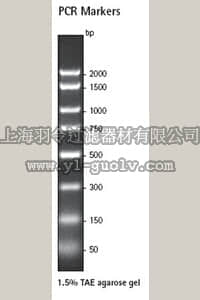 merck millipore,默克密理博,69278,PCR Markers, 50–2000 bp - Novagen
 merck millipore,默克密理博,ELI-004-H,IL-4 ELISPOT Antibody Pair, Human
 merck millipore,默克密理博,09-890,Anti-pan-AMPylated Threonine Antibody