- 当前位置:首页 > >Merck Millipore > 生命科学研究
- 生命科学研究
-

-
merck millipore,默克密理博,14-466,Insulin Receptor Protein, active, 10 µg
产品名称:Insulin Receptor Protein, active, 10 µg
产品型号:14-466
Active, recombinant human Insulin Receptor residues 1005-1310, containing an N-terminal His6-tag, for use in Kinase Assays.
merck millipore,默克密理博,14-466,Insulin Receptor Protein, active, 10 µg
- 产品介绍
描述 产品目录编号 14-466 品牌系列 Upstate
商名 - Upstate
描述 Insulin Receptor Protein, active, 10 µg 概述 Recombinant human Insulin receptor residues 1005-1310, containing an Nterminal His6-tag 应用 应用 Active, recombinant human Insulin Receptor residues 1005-1310, containing an N-terminal His6-tag, for use in Kinase Assays. 主要应用 - Kinase Assay
生物信息 来源 Expressed by baculovirus in Sf21 insect cells 品种 Human 特异活性 For Specific Activity data, refer to the Certificate of Analysis for individual lots of this enzyme. Entrez基因编号 - NM_001079817.1
- NM_000208.2
Entrez基因汇总 After removal of the precursor signal peptide, the insulin receptor precursor is post-translationally cleaved into two chains (alpha and beta) that are covalently linked. Binding of insulin to the insulin receptor (INSR) stimulates glucose uptake. Two transcript variants encoding different isoforms have been found for this gene. 基因符号 - HHF5
- INSR
- CD220
- IR
蛋白靶 IR 纯化方法 Ni2+/NTA-agarose 靶子系列 TK UniProt编号 - P06213
UniProt汇总 FUNCTION: SwissProt: P06213 # This receptor binds insulin and has a tyrosine-protein kinase activity. Isoform Short has a higher affinity for insulin. Mediates the metabolic functions of insulin. Binding to insulin stimulates association of the receptor with downstream mediators including IRS1 and phosphatidylinositol 3'-kinase (PI3K). Can activate PI3K either directly by binding to the p85 regulatory subunit, or indirectly via IRS1.
SIZE: 1382 amino acids; 156307 Da
SUBUNIT: Tetramer of 2 alpha and 2 beta chains linked by disulfide bonds. The alpha chains contribute to the formation of the ligand- binding domain, while the beta chains carry the kinase domain. Interacts with SORBS1 but dissociates from it following insulin stimulation. Binds SH2B2. Interacts with the PTB/PID domains of IRS1 and SHC1 in vitro when autophosphorylated on tyrosine residues. The sequences surrounding the phosphorylated NPXY motif contribute differentially to either IRS1 or SHC1 recognition. Interacts with the SH2 domains of the 85 kDa regulatory subunit of PI3K (PIK3R1) in vitro, when autophosphorylated on tyrosine residues. Interacts with SOCS7.
SUBCELLULAR LOCATION: Membrane; Single-pass type I membrane protein.
TISSUE SPECIFICITY: Isoform Long and isoform Short are expressed in the peripheral nerve, kidney, liver, striated muscle, fibroblasts and skin. Isoform Short is expressed also in the spleen and lymphoblasts.
PTM: After being transported from the endoplasmic reticulum to the Golgi apparatus, the single glycosylated precursor is further glycosylated and then cleaved, followed by its transport to the plasma membrane. & Autophosphorylated on tyrosine residues in response to insulin. & Phosphorylation of Tyr-999 is required for IRS1- and SHC1- binding.
DISEASE: SwissProt: P06213 # Defects in INSR are the cause of insulin resistance (Ins resistance) [MIM:125853]. & Defects in INSR are the cause of Rabson-Mendenhall syndrome [MIM:262190]; also known as Mendenhall syndrome. It is a severe insulin resistance syndrome characterized by insulin- resistant diabetes mellitus with pineal hyperplasia and somatic abnormalities. Typical features include coarse, senile-appearing facies, dental and skin abnormalities, abdominal distension, and phallic enlargement. Inheritance is autosomal recessive. & Defects in INSR are the cause of leprechaunism [MIM:246200]; also known as Donohue syndrome. Leprechaunism represents the most severe form of insulin resistance syndrome, characterized by intrauterine and postnatal growth retardation and death in early infancy. Inheritance is autosomal recessive. & Defects in INSR may be associated with noninsulin- dependent diabetes mellitus (NIDDM) [MIM:125853]; also known as diabetes mellitus type 2. & Defects in INSR are the cause of familial hyperinsulinemic hypoglycemia 5 (HHF5) [MIM:609968]. Familial hyperinsulinemic hypoglycemia [MIM:256450], also referred to as congenital hyperinsulinism, nesidioblastosis, or persistent hyperinsulinemic hypoglycemia of infancy (PPHI), is the most common cause of persistent hypoglycemia in infancy and is due to defective negative feedback regulation of insulin secretion by low glucose levels. & Defects in INSR are the cause of insulin-resistant diabetes mellitus with acanthosis nigricans type A (IRAN type A) [MIM:610549]. This syndrome is characterized by the association of severe insulin resistance (manifested by marked hyperinsulinemia and a failure to respond to exogenous insulin) with the skin lesion acanthosis nigricans and ovarian hyperandrogenism in adolescent female subjects. Women frequently present with hirsutism, acne, amenorrhea or oligomenorrhea, and virilization. This syndrome is different from the type B that has been demonstrated to be secondary to the presence of circulating autoantibodies against the insulin receptor.
SIMILARITY: SwissProt: P06213 ## Belongs to the protein kinase superfamily. Tyr protein kinase family. Insulin receptor subfamily. & Contains 2 fibronectin type-III domains. & Contains 1 protein kinase domain.产品使用声明 质量保证 routinely evaluated by phosphorylation of Axl-tide 使用声明 - Unless otherwise stated in our catalog or other company documentation accompanying the product(s), our products are intended for research use only and are not to be used for any other purpose, which includes but is not limited to, unauthorized commercial uses, in vitro diagnostic uses, ex vivo or in vivo therapeutic uses or any type of consumption or application to humans or animals.
储存和货运信息 存储条件 1year at -70C 包装信息 数量 10 µg
上一件merck millipore产品:merck millipore,默克密理博,14-552,BTK Protein, active, 10 µg
下一件merck millipore产品:merck millipore,默克密理博,F84-HG3,Manifold w/recirculating heater CellASIC ONIX-M
相关产品
 merck millipore,默克密理博,16-318,Anti-Akt/PKB Antibody, PH Domain, clone SKB1, Magnetic Bead Conjugate
 merck millipore,默克密理博,04-642,Anti-Ago2 Antibody, clone 9E8.2
 merck millipore,默克密理博,14-476M,Cdk7/Cyclin H/MAT1 (CAK complex) Protein, active, 250 µg
 merck millipore,默克密理博,SF-789,EPCAM; Human, Cyanine 5, RNA Detection Probe,SmartFlare
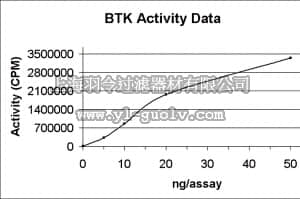 merck millipore,默克密理博,14-552,BTK Protein, active, 10 µg
 merck millipore,默克密理博,F84-HG3,Manifold w/recirculating heater CellASIC ONIX-M
 merck millipore,默克密理博,MR-010-D,EmbryoMax Modified M16 Medium (1X), w/o Phenol Red
merck millipore,默克密理博,AB3858,Anti-UbcH6 Antibody