


- 当前位置:首页 > >Merck Millipore > 生命科学研究
- 生命科学研究
-
-
merck millipore,默克密理博,ABE343,Anti-phospho-Chk2 (Thr68) Antibody
产品名称:Anti-phospho-Chk2 (Thr68) Antibody
产品型号:ABE343
Anti-phospho-Chk2 (Thr68) Antibody is a rabbit polyclonal antibody for detection of phospho-Chk2 (Thr68) also known as Serine/Threonine-Protein Kinase Chk2, Cds1 Homolog, Hucds1, Hcds1 & has been vali More>>
merck millipore,默克密理博,ABE343,Anti-phospho-Chk2 (Thr68) Antibody
- 产品介绍
重要规格表
品种反应性 主要应用 宿主 格式 抗体类型 Po, H WB Rb Affinity Purified Polyclonal Antibody 描述 产品目录编号 ABE343 描述 Anti-phospho-Chk2 (Thr68) Antibody Alternate Names - Checkpoint Kinase 2
- Serine/Threonine-Protein Kinase Chk2
- Chk2 Checkpoint Homolog
- Cds1 Homolog
- Hucds1
- Hcds1
背景信息 Chk2 (Cds1) is a serine/threonine nuclear kinase that plays an important role in cell-cycle arrest. Chk2 is phosphorylated by PLK3 and ATM proteins in response to breaks in double-stranded DNA. Chk2 then promotes cell-cycle arrest by phosphorylating and inhibiting CDC25 (A-C) phosphatases, thereby preventing activation of cell-cylce–promoting CDK-cyclins which are inhibited by tyrosine phosphorylation. Chk2 is also involved in mobilizing proteins, including BRCA2, for DNA repair. Chk2 also promotes apoptosis via the p53/TP53 signaling pathway. Importantly, Chk2 functions as a tumor suppressor. 产品信息 格式 Affinity Purified 控制 - Untreated And Etoposide Treated Jurkat Cell Lysates
演示 Purified rabbit polyclonal in buffer containing 0.1 M Tris-Glycine (pH 7.4), 150 mM NaCl with 0.05% sodium azide. 应用 应用 Anti-phospho-Chk2 (Thr68) Antibody is a rabbit polyclonal antibody for detection of phospho-Chk2 (Thr68) also known as Serine/Threonine-Protein Kinase Chk2, Cds1 Homolog, Hucds1, Hcds1 & has been validated in . 主要应用 - Western Blotting
生物信息 免疫原品种 KLH-conjugated linear peptide corresponding to human Chk2 phosphorylated at (Thr68). 表位 Phosphorylated (Thr68) 浓缩 Please refer to the Certificate of Analysis for the lot-specific concentration. 宿主 Rabbit 特异性 This antibody recognizes Chk2 phosphorylated at (Thr68). 品种反应性 PigHuman Species Reactivity Note Demonstrated to react in human. Predicted to react with pig based on 100% sequence homology. Other homologies: Bovine, Mouse, and Rat (89% sequence homology). 抗体类型 Polyclonal Antibody Entrez基因编号 - Np_665861
Entrez基因汇总 In response to DNA damage and replication blocks, cell cycle progression is halted through the control of critical cell cycle regulators. The protein encoded by this gene is a cell cycle checkpoint regulator and putative tumor suppressor. It contains a forkhead-associated protein interaction domain essential for activation in response to DNA damage and is rapidly phosphorylated in response to replication blocks and DNA damage. When activated, the encoded protein is known to inhibit CDC25C phosphatase, preventing entry into mitosis, and has been shown to stabilize the tumor suppressor protein p53, leading to cell cycle arrest in G1. In addition, this protein interacts with and phosphorylates BRCA1, allowing BRCA1 to restore survival after DNA damage. Mutations in this gene have been linked with Li-Fraumeni syndrome, a highly penetrant familial cancer phenotype usually associated with inherited mutations in TP53. Also, mutations in this gene are thought to confer a predisposition to sarcomas, breast cancer, and brain tumors. This nuclear protein is a member of the CDS1 subfamily of serine/threonine protein kinases. Three transcript variants encoding different isoforms have been found for this gene. [provided by RefSeq, Jul 2008]. 基因符号 - Rad53
- Chek2
- Cds1
- Chk2
修改 - Phosphorylation
纯化方法 Affinity purified UniProt编号 - O96017
UniProt汇总 FUNCTION: Serine/threonine-protein kinase which is required for checkpoint-mediated cell cycle arrest, activation of DNA repair and apoptosis in response to the presence of DNA double-strand breaks. May also negatively regulate cell cycle progression during unperturbed cell cycles. Following activation, phosphorylates numerous effectors preferentially at the consensus sequence [L-X-R-X-X-S/T]. Regulates cell cycle checkpoint arrest through phosphorylation of CDC25A, CDC25B and CDC25C, inhibiting their activity. Inhibition of CDC25 phosphatase activity leads to increased inhibitory tyrosine phosphorylation of CDK-cyclin complexes and blocks cell cycle progression. May also phosphorylate NEK6 which is involved in G2/M cell cycle arrest. Regulates DNA repair through phosphorylation of BRCA2, enhancing the association of RAD51 with chromatin which promotes DNA repair by homologous recombination. Also stimulates the transcription of genes involved in DNA repair (including BRCA2) through the phosphorylation and activation of the transcription factor FOXM1. Regulates apoptosis through the phosphorylation of p53/TP53, MDM4 and PML. Phosphorylation of p53/TP53 at 'Ser-20' by CHEK2 may alleviate inhibition by MDM2, leading to accumulation of active p53/TP53. Phosphorylation of MDM4 may also reduce degradation of p53/TP53. Also controls the transcription of pro-apoptotic genes through phosphorylation of the transcription factor E2F1. Tumor suppressor, it may also have a DNA damage-independent function in mitotic spindle assembly by phosphorylating BRCA1. Its absence may be a cause of the chromosomal instability observed in some cancer cells. Ref.1 CATALYTIC ACTIVITY: ATP + a protein = ADP + a phosphoprotein.
COFACTOR: Magnesium.
ENZYME REGULATION: Activated through phosphorylation at Thr-68 by ATM in response to DNA double-strand breaks. Activation is modulated by several mediators including MDC1 and TP53BP1. Induces homodimerization with exchange of the T-loop/activation segment between protomers and transphosphorylation of the protomers. The autophosphorylated kinase dimer is fully active. Negatively regulated by PPM1D through dephosphorylation of Thr-68.
SUBUNIT STRUCTURE: Homodimer. Homodimerization is part of the activation process but the dimer may dissociate following activation. Interacts with PML. Interacts with TP53. Interacts with RB1; phosphorylates RB1. Interacts with BRCA1. Interacts (phosphorylated at Thr-68) with MDC1; requires ATM-mediated phosphorylation of CHEK2. Interacts with TP53BP1; modulates CHEK2 phosphorylation at Thr-68 in response to ionizing radiation. Interacts with CDC25A; phosphorylates CDC25A and mediates its degradation in response to ionizing radiation. Interacts with CUL1; mediates CHEK2 ubiquitination and regulation.
SUBCELLULAR LOCATION: Isoform 2: Nucleus. Note: Isoform 10 is present throughout the cell.
Isoform 4: Nucleus
Isoform 7: Nucleus
Isoform 9: Nucleus
Isoform 12: Nucleus
Nucleus › PML body. Nucleus › nucleoplasm. Note: Recruited into PML bodies together with TP53.
TISSUE SPECIFICITY: High expression is found in testis, spleen, colon and peripheral blood leukocytes. Low expression is found in other tissues.
PTM: Phosphorylated. Phosphorylated at Ser-73 by PLK3 in response to DNA damage, promoting phosphorylation at Thr-68 by ATM and the G2/M transition checkpoint. Phosphorylation at Thr-68 induces homodimerization. Autophosphorylates at Thr-383 and Thr-387 in the T-loop/activation segment upon dimerization to become fully active and phosphorylate its substrates like for instance CDC25C. DNA damage-induced autophosphorylation at Ser-379 induces CUL1-mediated ubiquitination and regulates the pro-apoptotic function. Phosphorylation at Ser-456 also regulates ubiquitination. Phosphorylated by PLK4.
Ubiquitinated. CUL1-mediated ubiquitination regulates the pro-apoptotic function. Ubiquitination may also regulate protein stability.
INVOLVEMENT IN DISEASE: Defects in CHEK2 are associated with Li-Fraumeni syndrome 2 (LFS2) [MIM:609265]; a highly penetrant familial cancer phenotype usually associated with inherited mutations in p53/TP53.
Defects in CHEK2 may be a cause of susceptibility to prostate cancer (PC) [MIM:176807]. It is a malignancy originating in tissues of the prostate. Most prostate cancers are adenocarcinomas that develop in the acini of the prostatic ducts. Other rare histopathologic types of prostate cancer that occur in approximately 5% of patients include small cell carcinoma, mucinous carcinoma, prostatic ductal carcinoma, transitional cell carcinoma, squamous cell carcinoma, basal cell carcinoma, adenoid cystic carcinoma (basaloid), signet-ring cell carcinoma and neuroendocrine carcinoma.
Defects in CHEK2 are found in some patients with osteogenic sarcoma (OSRC) [MIM:259500].
Defects in CHEK2 is a cause of susceptibility to breast cancer (BC) [MIM:114480]. A common malignancy originating from breast epithelial tissue. Breast neoplasms can be distinguished by their histologic pattern. Invasive ductal carcinoma is by far the most common type. Breast cancer is etiologically and genetically heterogeneous. Important genetic factors have been indicated by familial occurrence and bilateral involvement. Mutations at more than one locus can be involved in different families or even in the same case. Note=CHEK2 variants are associated with susceptibility to breast cancer and contribute to a substantial fraction of familial breast cancer (Ref.17).
SEQUENCE SIMILARITIES: Belongs to the protein kinase superfamily. CAMK Ser/Thr protein kinase family. CHK2 subfamily.
Contains 1 FHA domain.
Contains 1 protein kinase domain.产品使用声明 质量保证 Evaluated by Western Blot in untreated and Etoposide treated Jurkat cell lysates.
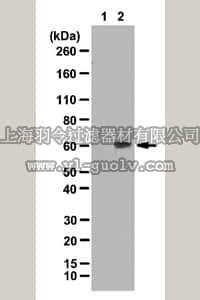
Western Blot Analysis: 0.2 µg/mL of this antibody detected Chk2 on 10 µg of untreated and Etoposide treated Jurkat cell lysates.储存和货运信息 存储条件 Stable for 1 year at 2-8°C from date of receipt. 包装信息 数量 100 µg
上一件merck millipore产品:merck millipore,默克密理博,MABN371,Anti-KChIP2 potassium channel subunit Antibody, clone 60/73
下一件merck millipore产品:merck millipore,默克密理博,AP147B,Rabbit Anti-Sheep IgG Antibody, biotin-SP conjugate
相关产品
 merck millipore,默克密理博,ABC850,Anti-CHORDC1 Antibody
 merck millipore,默克密理博,575545,Tankyrase1/2 Inhibitor, XAV939 - Calbiochem
 merck millipore,默克密理博,20-158,0.5M EDTA
 merck millipore,默克密理博,MABN371,Anti-KChIP2 potassium channel subunit Antibody, clone 60/73
 merck millipore,默克密理博,AP147B,Rabbit Anti-Sheep IgG Antibody, biotin-SP conjugate
 merck millipore,默克密理博,SF-1279,PICALM; Human, Cyanine 3 RNA Detection Probe,SmartFlare
 merck millipore,默克密理博,MABE431,Anti-PRMT1 Antibody, clone 7D2
 merck millipore,默克密理博,AB1529,Anti-Nitric Oxide Synthase I Antibody
 merck millipore,默克密理博,05-680,Anti-C-TAK1 (cdc25C associated protein kinase) Antibody